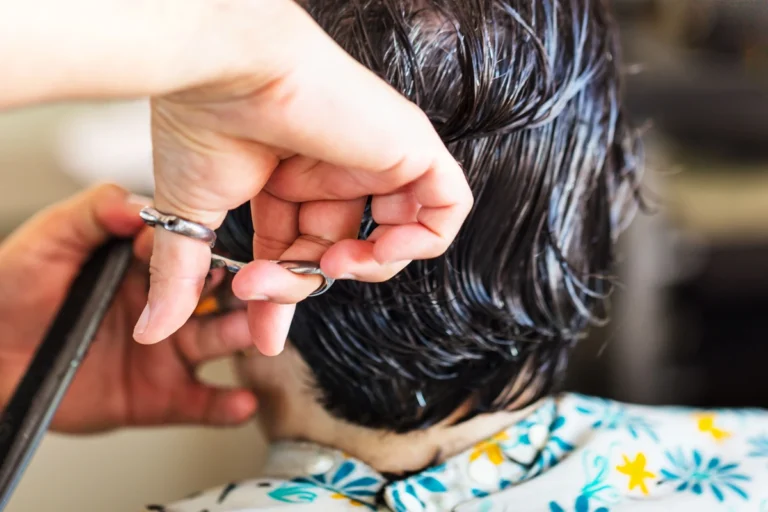

Curtain Bangs: 13 Styles for Every Face Shape and Hair Type
Curtain bangs are the easiest bangs to live with. They part in the center, sweep out to both sides, and blend into the rest of your haircut, so they frame your face without sitting across your forehead like a solid line. They also grow out gracefully: at six weeks past a trim they just look like long face-framing layers.
The look still varies a lot. A short, brow-skimming curtain on fine hair and a long, cheekbone-length curtain on thick waves are very different cuts. The styles below are grouped by length, by the haircut they’re paired with, and by texture, so you can match all three.
Quick answer: Curtain bangs suit almost every face shape when the length is right. Round and square faces do best with longer bangs that end at the cheekbone or jaw. Long faces look balanced with shorter, fuller bangs that start near the brows. Oval and heart-shaped faces can wear nearly any length.
Which Length Suits Your Face Shape
| Face shape | Best curtain bang length | Why it works |
|---|---|---|
| Oval | Any length | Balanced proportions, so length comes down to preference |
| Round | Cheekbone to jaw, angled | Long sides create vertical lines and slim the cheeks |
| Square | Jaw length, soft and wispy | Feathered ends soften a strong jaw and forehead corners |
| Long or oblong | Brow length, fuller center | Covers more forehead, which shortens the face visually |
| Heart | Cheekbone length | Covers the widest part of the forehead and draws focus to the eyes |
| Diamond | Cheekbone length, sweeping out | Adds width at the forehead to balance strong cheekbones |
Not sure about your face shape? Our guide to choosing a haircut for your face shape walks through the measuring method. Or use our face shape calculator to find yours in under a minute.
Curtain Bangs by Length
1. Long Curtain Bangs
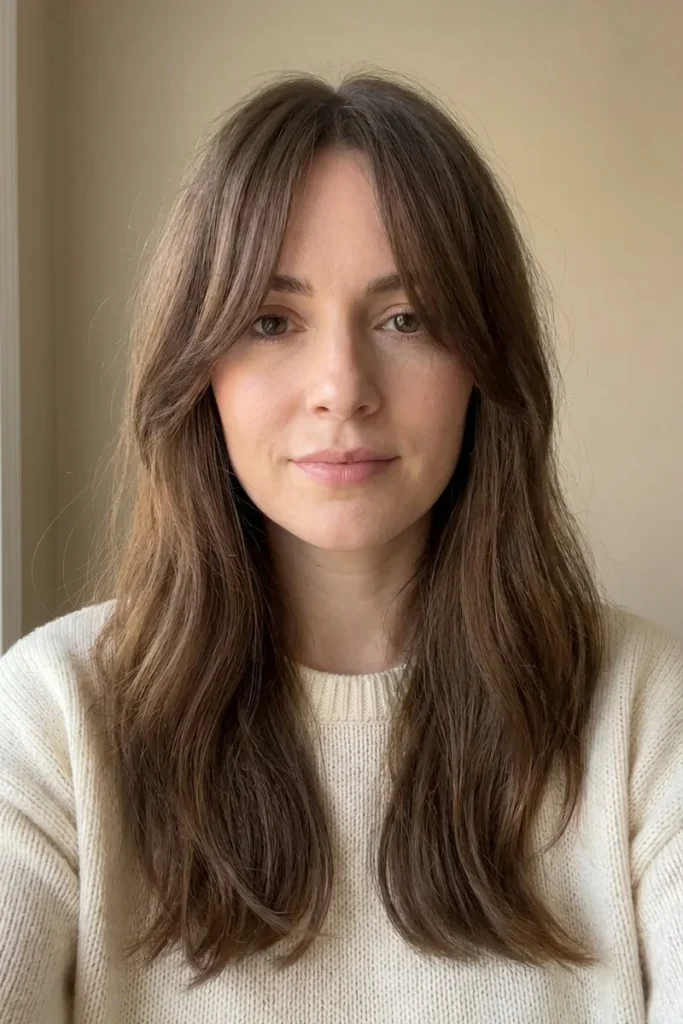
These start around the nose and fall past the cheekbones, often reaching the jaw. They’re the lowest-commitment version: you can tuck them behind your ears, pull them into a ponytail, or wear them as face-framing layers on days you don’t want bangs.
Long curtain bangs are the safest first try if you’ve never had bangs. If you hate them, you’ve lost very little length.
At the salon: Ask for curtain bangs that start at the tip of your nose and blend into your first layer at the jaw.
2. Cheekbone Curtain Bangs

This is the classic version. The center is shortest, around the bridge of the nose, and each side curves down to the top of the cheekbone. The curve draws the eye to the cheekbones and eyes, which is why this length flatters so many face shapes.
It needs a little more styling than the long version, because the short center has to be blow-dried to split cleanly.
At the salon: Say “shortest at the bridge of my nose, ending at my cheekbones,” and ask to see the length dry before the stylist cuts further.
3. Short, Brow-Grazing Curtain Bangs

The center sits just at or below the eyebrows, so these cover more forehead and read as a real fringe that parts in the middle. They’re a strong choice for long or oblong faces, since the extra coverage shortens the face.
They grow into your eyes fastest. Plan on trims every four weeks or so, or learn to snip the center yourself.
At the salon: Ask for a soft, piece-y center rather than a blunt one, so the split still looks deliberate as they grow.
4. Bottleneck Bangs

Bottleneck bangs sit between curtain bangs and full bangs. They’re narrow and short at the center, then widen as they curve around the eyes, like the shape of a bottle’s neck. They suit you if you want more coverage than curtain bangs but nothing as heavy as a straight-across fringe.
At the salon: Ask for a narrow center section that widens around the eyes and ends at the cheekbone.
Curtain Bangs Paired With Your Haircut
5. With Long Layers

This is the most popular pairing. The bangs flow straight into the face-framing layers, so the whole front looks like one soft, connected shape. A round-brush blowout makes it look like a salon finish on day two.
At the salon: Ask for the bangs to connect into your face-framing layers, with no visible gap between them. See our guide to layered haircuts for layer placement.
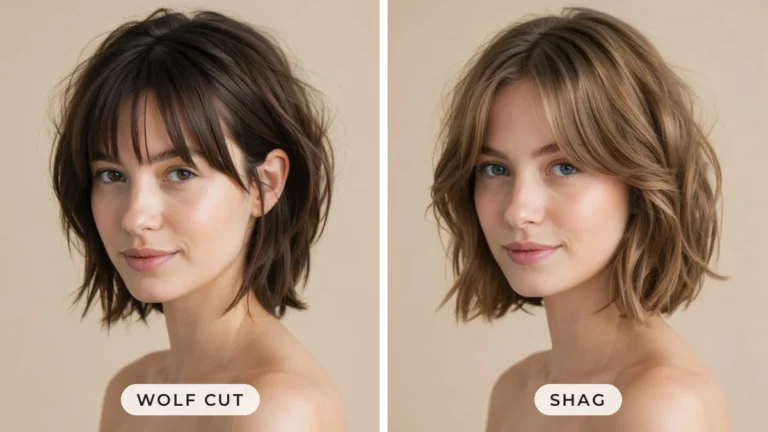
6. With a Shag
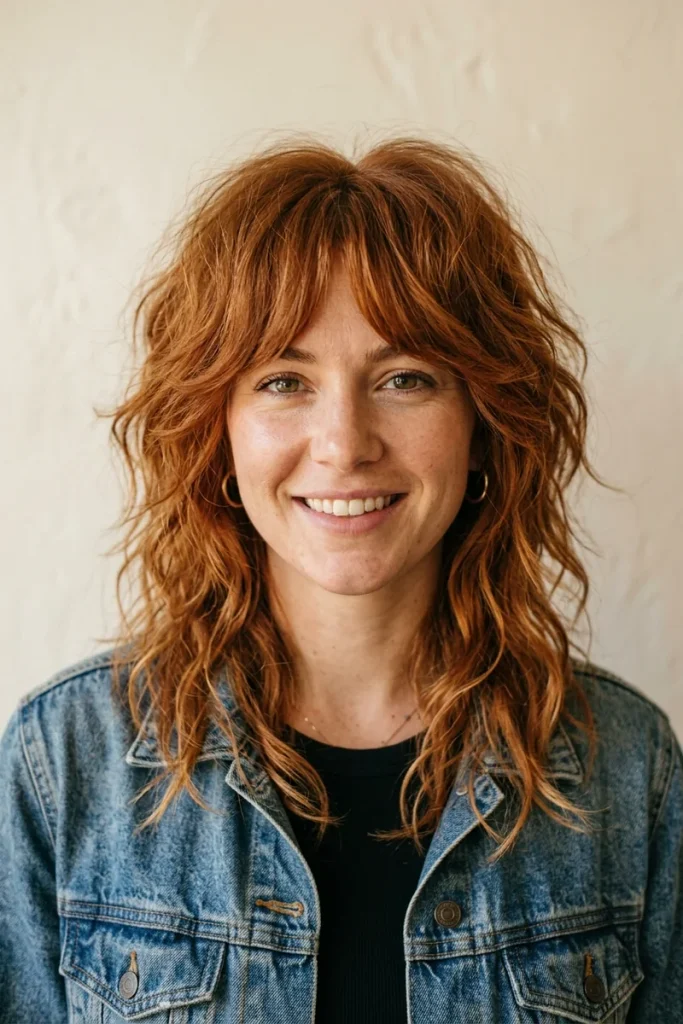
Curtain bangs are part of the classic shag outline. Here they’re cut a little choppier and textured with a razor or point-cutting, so they match the piece-y layers through the crown. Air-dry with a texture spray and let the bangs fall where they want.
At the salon: Ask for textured, point-cut ends rather than a smooth curve. Our shag haircuts guide covers which shag length fits your hair.
7. With a Bob
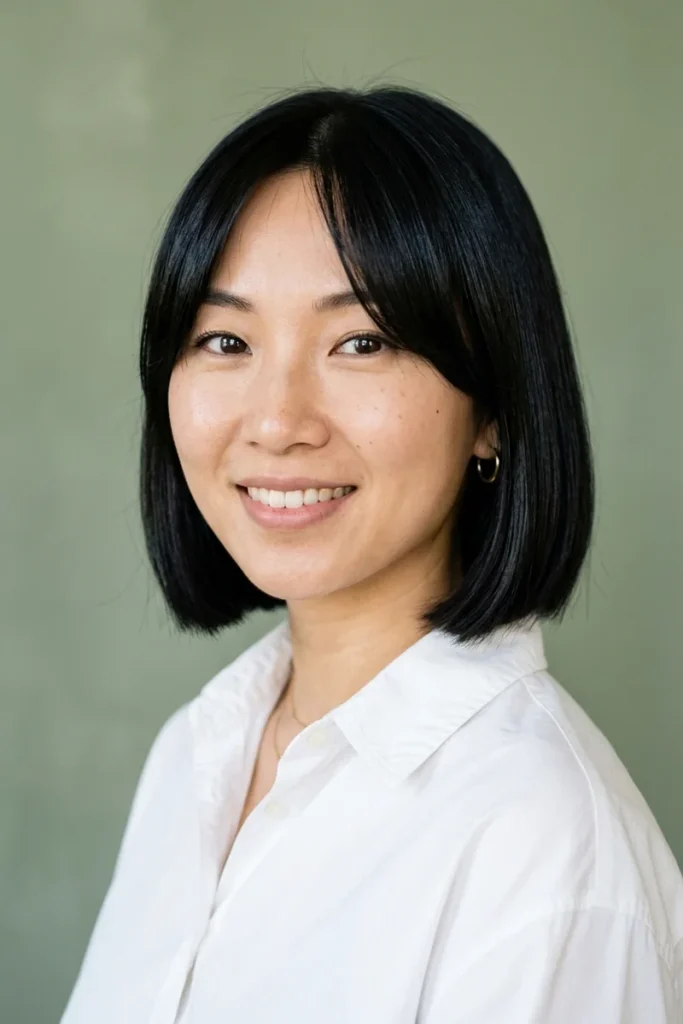
On a chin-length bob, curtain bangs add softness to a sharp outline. On a blunt bob, keep the bangs light so they don’t make the front look heavy. On a textured bob, cut them as piece-y as the ends.
At the salon: Ask for the bangs to end above the bob’s bottom line, around the cheekbone, so the two lengths don’t compete. Browse more cuts in our bob haircut guide.
8. With a Lob or Shoulder-Length Cut
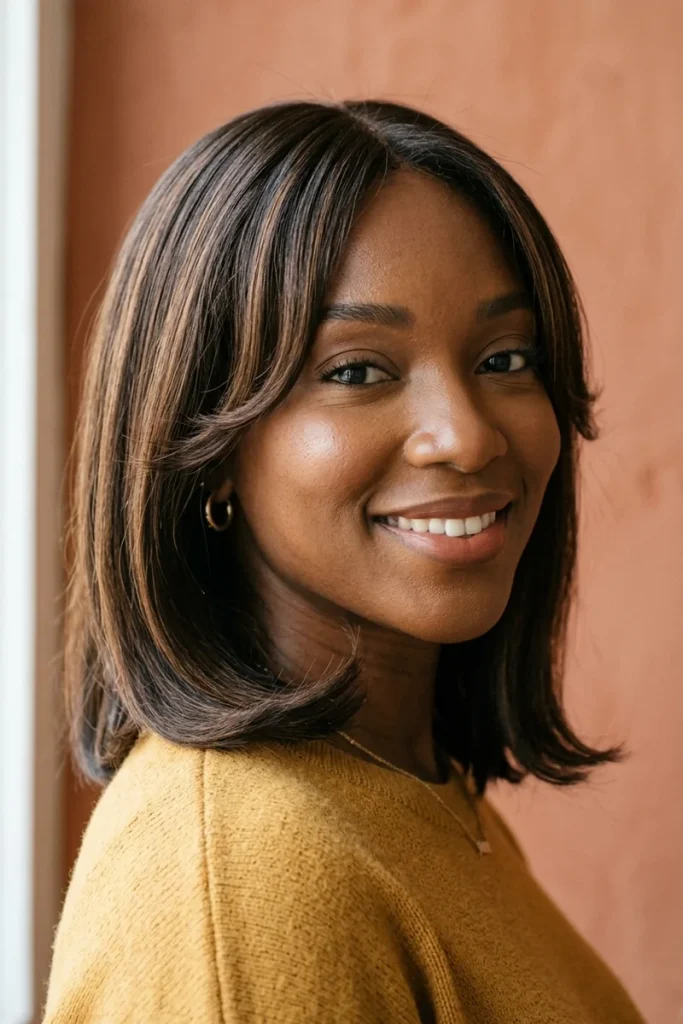
A lob with curtain bangs is the easiest everyday version. It’s long enough for a low ponytail or half-up style, and the bangs keep the front looking styled even when the rest is simply air-dried.
On half-up days, leave the bangs out and pull back only the section behind them. Our half-up half-down hairstyles guide has easy options.
At the salon: Ask for jaw-to-cheekbone curtain bangs and long, light layers around the face.
9. With a Wolf Cut
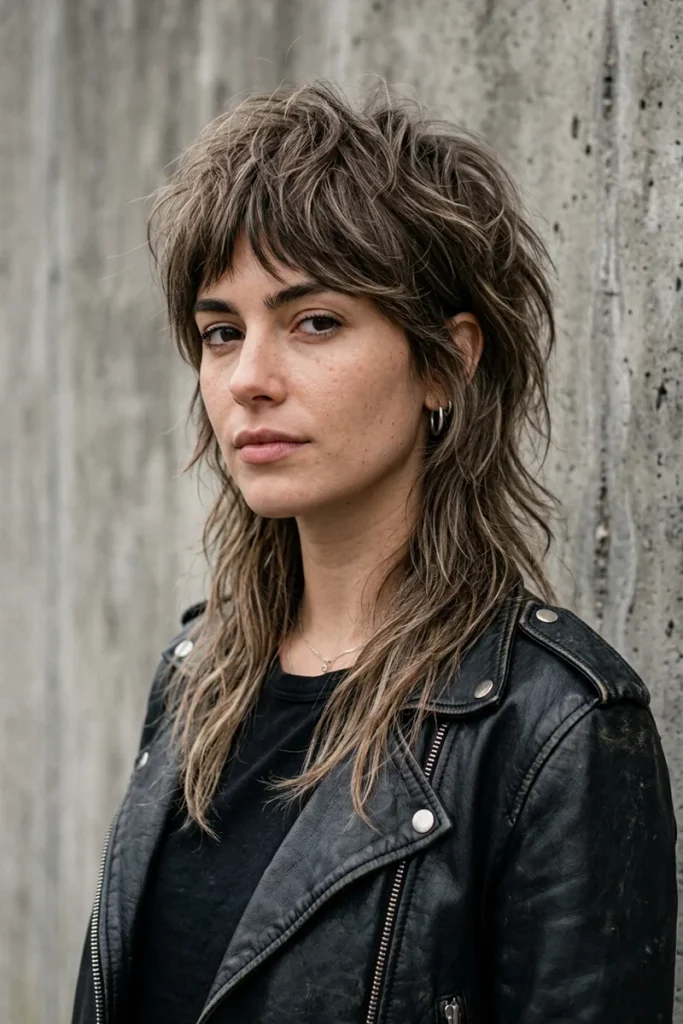
A wolf cut needs curtain bangs to finish its shape. The heavy, choppy crown and lighter, longer ends rely on bangs that blend into the top layers. Here they’re usually shorter and more textured than on a layered cut.
At the salon: Ask for bangs that connect into the short crown layers, not a separate fringe. Our wolf cut guide shows which version suits your hair type.
Curtain Bangs by Hair Texture
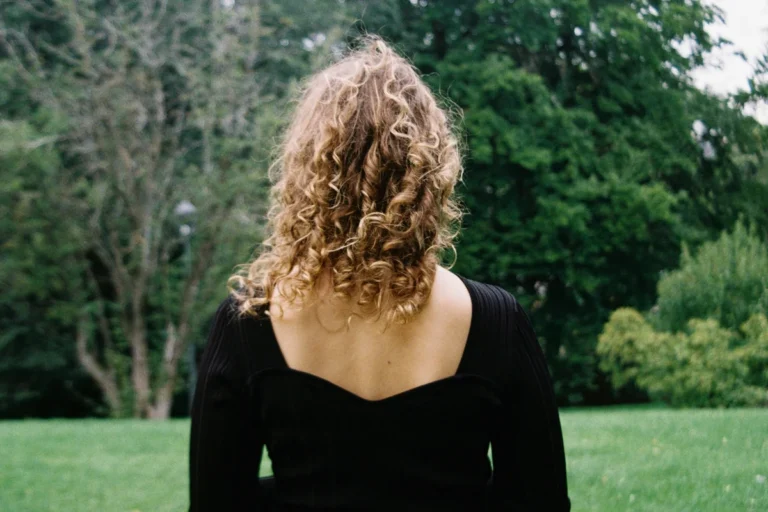
10. Curly Curtain Bangs
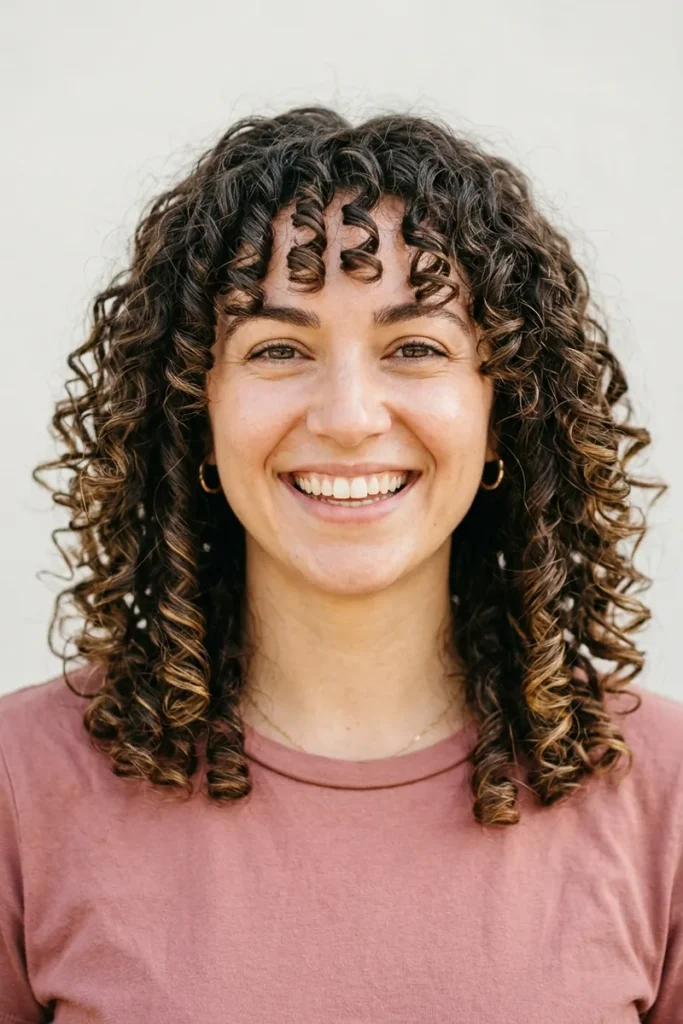
Curly curtain bangs have to be cut dry, one curl at a time. Curls shrink as they dry, so bangs cut wet and stretched can spring up much shorter than planned. The result is a rounded, open fringe that frames the face without needing heat.
Style them the same way as the rest of your curls: gel or cream while wet, then air-dry or diffuse. Our guide to curly hairstyles by curl type covers routines for each curl pattern.
At the salon: Ask for a dry cut and have the stylist leave the bangs a little long. You can always take more off at the next visit.
11. Wavy Curtain Bangs
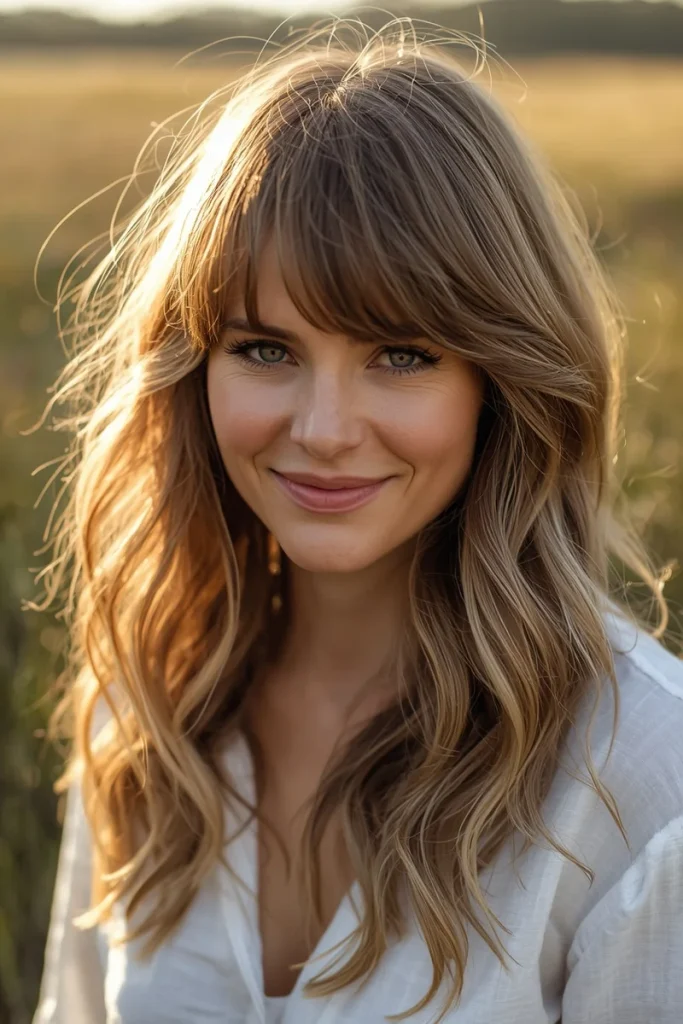
Wavy hair gives curtain bangs a natural bend that falls away from the face. You can scrunch them with the rest of your waves, or smooth just the bangs with a round brush and leave the lengths wavy.
At the salon: Ask for slightly longer bangs than you’d want straight, since the wave pulls them up.
12. Curtain Bangs for Fine or Thin Hair

The worry with fine hair is that bangs take too much hair away from the rest of the cut. The fix is a shallow, narrow bang section. Curtain bangs only need a small triangle from the front hairline, so the lengths keep their density.
Fine bangs get oily faster because they touch the forehead. A little dry shampoo at the roots of the bangs helps them last an extra day. Pair them with a one-length collarbone cut so the ends stay as full as the bangs; more options are in our haircuts for fine, thin hair guide.
At the salon: Ask for a shallow, wispy section, and for the stylist to avoid heavy thinning on the rest of the hair.
13. Curtain Bangs for Thick Hair

On thick hair, curtain bangs can puff out or sit like a heavy block if they’re cut too dense. Internal thinning or point-cutting removes weight from inside the bangs, so they move and split instead of sticking out.
At the salon: Ask for weight to be removed from inside the bangs while the edge stays soft.
How to Style Curtain Bangs in 5 Minutes
Curtain bangs are styled while damp, before the rest of your hair. Once they’ve dried flat, they’re hard to reshape.
- Wet just the bangs if the rest of your hair is already dry. A spray bottle or a damp hand is enough.
- Blow-dry the roots forward first, with the nozzle pointing down. This removes any cowlick lift and sets the center split.
- Use a round brush (or a flat paddle brush) to roll each side out and away from your face, one side at a time.
- Use a Velcro roller on the center section for a few minutes while you do your makeup, if you want more lift.
- Finish with a light texture spray, not a heavy cream, so the bangs keep their movement.
Use a heat protectant before blow-drying, since the bangs get heat more often than the rest of your hair. See our heat damage guide for the right temperature for your hair type.
No-heat option: Before bed, roll the dry bangs around one large Velcro roller, or twist each side away from your face and pin it. In the morning, a few minutes is enough to set the curve.
Common Curtain Bang Mistakes
- Cutting them wet. Bangs shrink as they dry, especially on wavy and curly hair. Cut dry, or leave them long.
- Making the center too short. A center above the brows can look blunt instead of curtain-like.
- Ignoring a cowlick. A strong cowlick at the front hairline makes the bangs split unevenly. Blow-drying the roots forward fixes most cowlicks, and a stylist can position the part to work with yours.
- Using heavy products. Oils and creams weigh the bangs down and make them separate into strings.
- Skipping trims. Curtain bangs grow out gracefully, but past a certain point the curve is gone and they just look like uneven layers.
How Often to Trim Curtain Bangs
Curtain bangs need a trim every 4 to 6 weeks to keep the curve. Shorter, brow-length versions need it closer to four weeks; long, jaw-length versions can go six or more. Many salons offer quick bang trims between full haircuts. For trim timing on the rest of your cut, see our guide on how often you should trim your hair.
FAQ
Do curtain bangs suit a round face?
Yes. Choose longer curtain bangs that end at the cheekbone or jaw and angle away from the face. The long sides create vertical lines, which make the face look longer. Very short, wide bangs can make a round face look wider.
Are curtain bangs high maintenance?
They’re lower maintenance than straight-across bangs. They need a quick blow-dry most days and a trim every 4–6 weeks, but they grow out gracefully and can be tucked behind the ears or pinned back.
Can you get curtain bangs with curly hair?
Yes. Ask for a dry cut, curl by curl, and keep them a little longer than you think you want. Curls shrink as they dry, so dry cutting is the only reliable way to see the final length.
How long does it take to grow out curtain bangs?
Usually 3 to 6 months, depending on their length. Long curtain bangs blend into face-framing layers within a few months, while short, brow-length ones take longer to reach the rest of the haircut.
Should I cut curtain bangs myself?
A small trim on the center section is doable with sharp hair-cutting scissors, cutting dry and vertically into the ends. Cutting new curtain bangs from scratch is harder to get even, so it’s best left to a stylist.
Final Thoughts
Pick the length first: from the face-shape table, or long if you’re unsure. Then choose the version that matches your haircut and texture, and bring a photo of that exact style to the salon. If you’d like a full new cut with your bangs, our layered haircuts by length guide and pixie cut guide are good places to compare.