
How to Choose a Haircut for Your Face Shape (Measure First, Then Match)
Most people choose a haircut backwards. They find a photo they love, take it to a salon, sit down, and hope. Then the cut comes out technically perfect and still looks somehow off — and nobody can explain why.
The reason is almost always proportion. A haircut doesn’t sit on your head in isolation; it sits next to your forehead, your cheekbones and your jaw, and it either balances those three or it fights them. The same blunt bob that sharpens one person’s face will widen another’s. Nothing was wrong with the cut. It was wrong for the face underneath it.
This guide fixes that in the right order: measure first, identify your shape second, match the cut third. By the end you’ll know which lengths and layers work with your bone structure, which ones to be careful with, and exactly what to say at the salon so you don’t walk out with something you didn’t ask for.
The Principle Behind Every Face Shape Rule
Stylists aren’t following a chart. They’re solving one problem: where is the visual weight, and where does it need to go?
Hair adds weight wherever it has volume, and removes it wherever it’s sleek or tapered. That’s the entire mechanic.
- If your face is wide, you want weight below the widest point and length that pulls the eye down.
- If your face is long, you want weight at the sides and something breaking up the vertical line — usually bangs.
- If your face has a strong angle (a square jaw, a pointed chin), you want softness and movement near that angle, not a hard horizontal line.
- If your face is already balanced, you can do almost anything — which is why oval gets called the “easy” one.
Nearly every recommendation below comes from those four sentences. Once you understand the logic, you stop needing the chart.
Step 1: Measure Your Face (60 Seconds, Four Numbers)
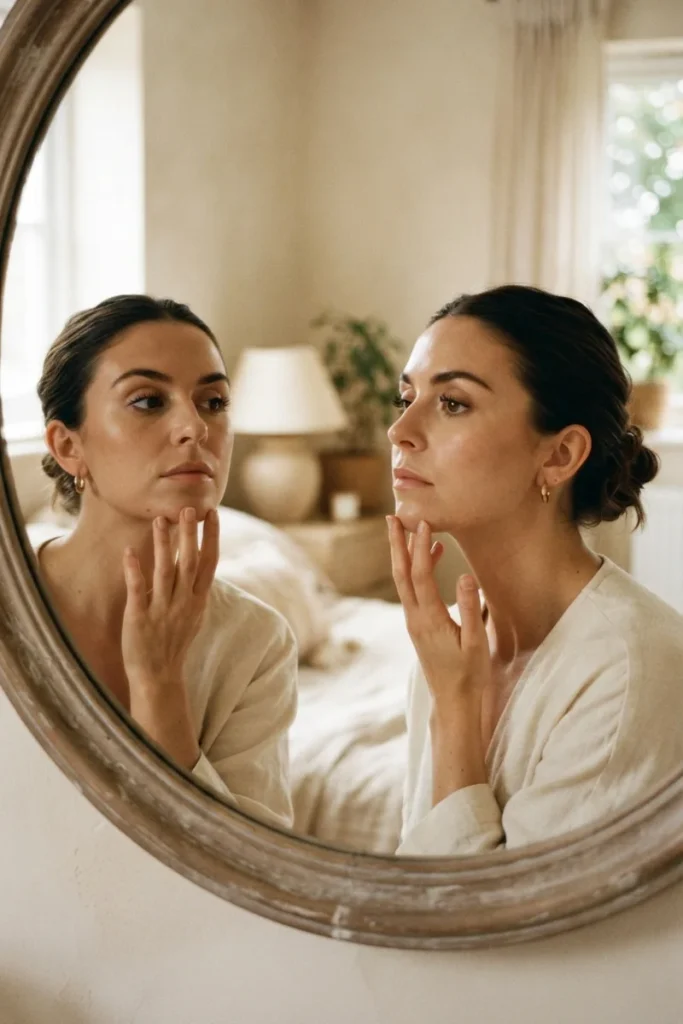
Guessing your face shape in a mirror is where most people go wrong — you’re looking at your hair, your eyebrows and your expression, not your outline. Measuring removes the guesswork.
Pull your hair back completely. Grab a soft tape measure (a piece of string and a ruler works too). Take these four:
- Forehead — across the widest point, roughly halfway between your eyebrows and your hairline.
- Cheekbones — from the outer corner of one eye, straight across the top of the cheekbones, to the other.
- Jawline — from below one ear to the tip of your chin, then double that number.
- Face length — from the center of your hairline straight down to the bottom of your chin.
No tape measure handy? Two rough stand-ins work almost as well: trace your face directly onto a mirror with a washable liner while looking straight ahead, or take a straight-on photo with your hair pulled back and even lighting, then look at the outline on its own instead of your features.
Write all four down. Now read them:
| What the numbers show | Your likely shape |
|---|---|
| Length clearly biggest; cheekbones slightly wider than jaw; softly rounded chin | Oval |
| Length and cheekbones almost equal; cheeks the widest point; soft chin | Round |
| Forehead, cheekbones and jaw all similar; sharp, defined jaw corners | Square |
| Forehead widest; narrow, pointed chin | Heart |
| Cheekbones clearly widest; forehead and jaw both narrow; pointed chin | Diamond |
| Length much bigger than width; forehead, cheeks and jaw all similar; straight sides | Oblong / Rectangle |
| Jaw widest; forehead narrowest | Pear / Triangle |
| Forehead widest; jaw narrower, tapering softly to a small, less pointed chin | Inverted Triangle |
Two notes before you go further. Many people land between two shapes — that’s normal, and there’s a section on it below. And if your measurements say one thing but your reflection says another, trust the tape. Hair, makeup and brows lie to you in a mirror.
Step 2: The 8 Face Shapes and What Actually Works
Oval
How to recognize it: Face length is noticeably greater than width, cheekbones sit as the widest point, forehead is marginally wider than the jaw, and the chin curves rather than points.

The goal: Nothing needs correcting, so the job is simply to avoid creating an imbalance.
Works well:
- Long layers starting at the jaw or below
- Blunt or textured lobs
- Curtain bangs
- Soft waves and a deep side part
- Almost any mid-length cut
Be careful with: Very long, one-length hair with no layers. It stretches an already-long shape and flattens the sides. If you want length, get face-framing layers so there’s movement somewhere.
Because the proportions are balanced, almost any cut holds together on an oval face, which is why stylists treat it as the easiest shape to work with. That leaves texture, density and how much time you’ll spend styling as the real deciding factors.
Round
How to recognize it: Length and width are close to equal, the cheeks are the widest point, and there’s no hard angle at the jaw.

The goal: Add vertical length and introduce some structure where there currently isn’t any.
Works well:
- Long layers that start below the chin
- Angled lobs — shorter at the back, longer at the front
- Asymmetrical bobs
- Deep side parts (they create a diagonal, which reads as length)
- Long curtain bangs that split and fall past the cheekbones
- Height or volume at the crown
Be careful with: Blunt chin-length bobs, straight-across heavy bangs, and center parts on very short hair. Each of them draws a horizontal line at the widest part of your face, which is the one thing you’re trying to avoid.
A practical tip most charts skip: round faces benefit far more from texture than from length alone. Waist-length hair that’s poker-straight still won’t slim a round face. Movement breaks the circle; length by itself doesn’t.
An easy everyday version of this: a deep side part with soft waves adds the diagonal line round faces benefit from without cutting a single layer.
Square
How to recognize it: Forehead, cheekbones and jaw measure close to the same, and the corners of the jaw are visibly defined.

The goal: Soften the corners without hiding the structure — a strong jaw is a feature, not a flaw.
Works well:
- Soft, blended layers starting around the cheekbone
- Long shags with lots of movement
- Waves and curls, especially through the mid-lengths
- Wispy or side-swept bangs
- Shoulder-length layered cuts
- Collarbone-length lobs
Be careful with: Any blunt cut that ends exactly at the jaw. It runs a straight line parallel to your jawline and doubles the angle. Move the length an inch above or two inches below and the same cut suddenly flatters.
Braids that frame the face softly do a version of this same job without any scissors — worth trying between haircuts.
Heart
How to recognize it: The forehead is the widest measurement and the chin narrows to a point.

The goal: Reduce width at the top, add visual weight at the bottom.
Works well:
- Chin-length or collarbone bobs with weight at the ends
- Side-swept bangs (they cut the forehead width diagonally)
- Curtain bangs
- Layers that begin at the jaw, not the cheekbone
- Soft waves through the bottom third
Be careful with: Short pixies with volume piled on top, slicked-back styles, and heavy blunt bangs that emphasize forehead width. Also avoid layers that stop short at the cheekbone — they pull the eye upward, which is the wrong direction.
Diamond
How to recognize it: Cheekbones are clearly the widest point; both the forehead and the jaw are narrow.

The goal: Add a little width at the forehead and the jaw so the cheekbones stop dominating.
Works well:
- Chin-length bobs with blunt ends
- Textured lobs
- Side-swept or curtain bangs (they widen the forehead visually)
- Medium-length layers finishing around the jaw
- Fullness at the ends and around the forehead, less through the middle
- Textured pixies with side-swept bangs and a little length left at the sides (the bangs add forehead width)
Be careful with: Slicked-back styles, tight high ponytails and very short layers around the cheekbone — all three pull hair tight against the widest part of your face and exaggerate it.
Oblong / Rectangle
How to recognize it: Face length is significantly greater than width, and the sides run relatively straight from forehead to jaw.

The goal: Shorten the vertical line and build width at the sides.
Works well:
- Shoulder-length to collarbone cuts
- Blunt bobs with body
- Waves and curls (they add horizontal volume)
- Curtain bangs or soft full bangs
- Layers that add fullness at the cheekbone rather than at the ends
Be careful with: Very long straight hair, high volume at the crown, and center-parted styles with no bangs. All of them extend the line you’re trying to shorten.
Bangs do more for this shape than for any other. If you’ve been avoiding them, this is the face shape where good bangs genuinely transform the proportions.
If bangs aren’t for you, a low, textured braid to add width at the sides does something similar without any cutting.
Pear / Triangle
How to recognize it: The jaw is the widest measurement and the forehead is the narrowest — the opposite of a heart shape.
The goal: Build volume at the top and keep it off the jaw.
Works well:
- Volume and layers above the cheekbone
- Pixies and short crops with height at the crown
- Side parts with lift at the root
- Shoulder-grazing layered cuts that taper away from the jaw
- Long, side-swept bangs
Be careful with: Chin-length bobs with heavy, blunt ends. They deposit weight exactly where the face is already widest.
Plenty of face shape guides skip this shape or lump it in with “square,” so a lot of people spend years following square-face advice that keeps backfiring.
Inverted Triangle
How to recognize it: A broad forehead paired with a jaw that tapers softly to a narrow chin — smaller than the forehead, but usually less pointed than a heart shape.

The goal: Soften the top and add fullness low, near the chin.
Works well:
- Mid-length cuts with weight around the chin and collarbone
- Soft curtain bangs
- Waves that start at the cheekbone and build downward
- Chin-length layers
Be careful with: Blunt bangs across a wide forehead, and tightly pulled-back styles.
If you love bangs, keep them long, wispy and parted so they blend into the sides rather than sitting as a straight line across the forehead.
The Part Most Face Shape Charts Skip: Texture and Density Override Everything
Here’s the uncomfortable truth about face shape guides — including this one. Your hair type can overrule your face shape entirely.
A blunt bob doesn’t behave the same way on fine straight hair as it does on thick curls. On fine hair it reads as sleek and sharp. On coarse curly hair the same cut expands sideways and turns into a triangle. Same instruction, opposite result.
Use this as a second filter after you pick your shape:
| Your hair | What it does to a cut | Adjust by |
|---|---|---|
| Fine, low density | Layers thin out the ends and make hair look sparser | Choosing blunter lines; keeping layers long and few |
| Fine, high density | Holds shape well; bluntness looks intentional | Almost anything — this is the most flexible hair type |
| Thick, straight | Builds bulk at the perimeter; can look heavy | Internal layers to remove weight without losing the line |
| Wavy | Shrinks 1–2 inches when dry; widens at the mid-lengths | Cutting longer than target; layering to control the widest point |
| Curly | Shrinks significantly; volume collects at the sides | Cutting curl by curl; layers placed to stop side expansion |
| Coily | Maximum shrinkage; shape is built, not fallen | Sculpting the silhouette rather than following length rules |
If you’re working with natural texture, our curly hair styling guide breaks down cutting and product routines curl-pattern by curl-pattern.
The practical version: if your face shape says “add width at the sides” and you already have voluminous curly hair, you’ve got that covered. Skip that instruction and focus on the rest.
Lifestyle is the third filter, and people ignore it constantly. A layered cut that needs twenty minutes with a round brush is a bad cut for someone who air-dries and leaves the house in ten. The best haircut for your face shape is the one you’ll actually style — not the one that photographs well on day one.
Bangs, by Face Shape
Bangs are the single fastest way to change facial proportion, and the type matters far more than whether you have them.
| Face shape | Best bang type | Avoid |
|---|---|---|
| Oval | Almost any — curtain, blunt, wispy | Nothing in particular |
| Round | Long curtain bangs, side-swept | Blunt straight-across |
| Square | Wispy, soft side-swept | Heavy blunt bangs |
| Heart | Side-swept, curtain | Thick blunt bangs |
| Diamond | Curtain, side-swept | Very short micro bangs |
| Oblong | Full blunt bangs, curtain | No bangs at all |
| Pear | Long side-swept | Short blunt |
| Inverted Triangle | Soft curtain | Wide blunt bangs |
Color Can Do the Same Job as a Cut
Cutting isn’t the only lever here. Color placement works on the same “where does the weight need to go” logic as a haircut — lighter shades pull the eye forward and add visual fullness, while deeper shades recede. Keep the color around a wide forehead deeper and softly blended, and put brighter face-framing pieces near the jaw, which adds exactly the kind of width a heart or diamond shape is working toward. If you’d rather adjust color before committing to scissors, our hair color ideas and balayage guide cover placement in more depth.
If You Wear Glasses
Frames sit on the exact part of your face that your haircut is trying to balance, so they count.
- Wide or bold frames already add width at the cheekbone — so a round or square face should lean on length and layers rather than side volume.
- Heavy top bars add visual weight to the forehead, which suits a pear shape and works against a heart shape.
- Bangs plus glasses need the bangs to end above the frame line, not on it. Bangs resting on your lenses read as untidy no matter how well they’re cut.
Bring your glasses to the appointment and put them on before the consultation, not after the cut.
If You’re Between Two Shapes
Many people are. A common mix is oval-heart, or round-square, or square-oblong.
Don’t try to average them. Instead, pick the feature you most want to balance and style for that one. If you’re round-square, ask yourself which bothers you more: the softness of the cheeks or the sharpness of the jaw. Solve that, and the rest usually falls into place.
If you genuinely can’t decide, default to the instruction both shapes agree on. Round and square, for example, both benefit from soft layers and movement — so start there and adjust later.
What to Say at the Salon (Word for Word)
A reference photo alone is the weakest thing you can bring to a consultation, because it shows a result without any of the conditions that produced it — that person’s density, texture, growth pattern and styling time.
Say this instead:
“My face is widest at the cheekbones and my chin is fairly pointed. I’d like to keep some weight around the jaw rather than above it. My hair is fine and wavy, it shrinks about an inch when it dries, and I air-dry most mornings — I’ve got maybe five minutes. Can we do something that holds its shape without a blow-dry?”
That one paragraph gives a stylist everything: proportion, texture, shrinkage, and your realistic styling window. Adapt the specifics to your own measurements.
Two more questions worth asking before the scissors come out:
- “How will this look in eight weeks when it grows out?”
- “What do I have to do every morning to make this sit right?”
If the answer to the second one is longer than your actual routine, ask for a lower-maintenance version of the same shape.
Five Mistakes That Make a Good Cut Look Wrong
- Measuring with your hair down. Your hairline is part of the outline. Pull everything back first.
- Copying a photo of someone with different hair density. The same cut on thicker hair is a different haircut.
- Ignoring shrinkage on wavy and curly hair. A cut that looks right wet can land two inches shorter dry.
- Cutting for an event instead of for your life. The style that works at a wedding often doesn’t survive a Tuesday.
- Treating face shape rules as laws. They’re a starting point. Confidence in a cut beats correctness every time.
Frequently Asked Questions
How do I know my exact face shape?
Pull your hair back and take four measurements: forehead width, cheekbone width, jaw width and total face length. Compare which is largest and whether the length clearly exceeds the width. The table earlier in this guide turns those four numbers into a shape.
Can I have more than one face shape?
Yes, and many people do. Combination shapes like oval-heart or round-square are extremely common. In that case, style for the single feature you most want to balance rather than trying to satisfy both.
Do bangs suit every face shape?
Nearly every face shape can wear bangs — the type is what changes. Long curtain bangs flatter round faces, wispy bangs soften square jaws, and full blunt bangs shorten an oblong face. Blunt bangs on a round face are one of the few genuinely unflattering combinations.
What haircut makes your face look slimmer?
Long layers, angled lobs, deep side parts and any style with vertical movement. The common thread is a diagonal or vertical line rather than a horizontal one, and length that continues past the widest point of the face.
Does face shape matter more than hair texture?
No. Texture and density decide how a cut behaves; face shape decides what shape you’re aiming for. Work out the shape first, then adjust the execution for your hair type.
Should I follow trends or face shape rules?
Face shape guidelines exist to explain why something works, not to restrict you. If a trend appeals to you, use the principles here to find the version of it that suits your proportions — most trends have several.
How often should I recut to keep the shape?
Shorter, structured cuts like bobs and pixies lose their shape in six to eight weeks. Long layered cuts hold for twelve to sixteen. The more the cut depends on a precise line, the sooner it needs revisiting.
Can I change my apparent face shape without cutting my hair?
To a degree, yes. Parting, volume placement and how you wear your hair back all shift apparent proportion. A deep side part alone can visibly lengthen a round face, and a soft braid framing the face narrows a square jaw more than most people expect.
Do updos and braids need to follow face-shape rules too?
Yes — placement works the same way it does for a haircut. Heart and diamond shapes generally do best with lower, looser styles like a soft bridal updo or a half-up-half-down style, since crown volume works against both shapes, while round faces can usually handle higher, more structured looks like the ones in our bun hairstyles guide.
Final Thoughts
The right haircut isn’t the one trending this month, and it isn’t the one that looked incredible on someone with completely different bone structure. It’s the one that balances what’s already there and survives your actual morning routine.
Start with the tape measure. Find where your face is widest. Decide where the weight needs to move. Then bring that information — not just a photo — to your stylist.
Everything after that is detail. Once you know your shape, browse every haircut guide to see the full style in action.




2 Comments