
Blunt Bob vs Textured Bob: Which One Actually Suits You
Every bob eventually comes down to one decision at the chair: keep the ends clean and sharp, or break them up. That single choice — blunt or textured — changes how the cut looks, how much upkeep it needs, and how forgiving it is on a rushed morning. Get it backwards for your hair and lifestyle, and even a technically perfect haircut can feel like the wrong one.
This guide compares the two side by side, so you walk in already knowing which one is actually built for you.
The Quick Answer
| Blunt Bob | Textured Bob | |
|---|---|---|
| Look | Sharp, graphic, one clean line | Soft, piece-y, broken-up ends |
| Best hair type | Straight to slightly wavy, fine to medium | Thick, wavy, or curly |
| Styling time | Higher — needs a straightener or round brush to keep the line crisp | Lower — works with air-drying and texture product |
| Trim frequency | Every 6–8 weeks | Every 8–10 weeks |
| Forgives growth | Poorly — a grown-out line looks uneven fast | Well — layers disguise regrowth |
| Face shapes it flatters | Oval, round (the straight line adds definition) | Square, heart (the broken ends soften angles) |
If you read nothing else: blunt rewards precision and upkeep; textured rewards low-maintenance texture. Everything below explains why.
What a Blunt Bob Actually Is
A blunt bob is cut in one continuous, straight line, with no layering to break it up. Every strand ends at the same length, which is what gives it that dense, polished look.

The goal: Maximum density and a graphic, intentional silhouette.
Works well on:
- Fine to medium hair — the unbroken weight line creates the illusion of thickness
- Straight or barely-wavy hair, which holds the line without fighting it
- Anyone who wants the cut to look deliberate rather than casual
Be careful with: Thick or very curly hair. Without layers, weight has nowhere to go, and a blunt line on thick or curly hair can end up looking triangular — heavier at the bottom than it should be — rather than sleek.
Styling reality: A blunt bob needs regular smoothing to look its best. Most people either blow-dry with a round brush or run a flat iron through it. Skip a day of styling and the line can start looking soft rather than sharp, especially in humidity.
What a Textured Bob Actually Is
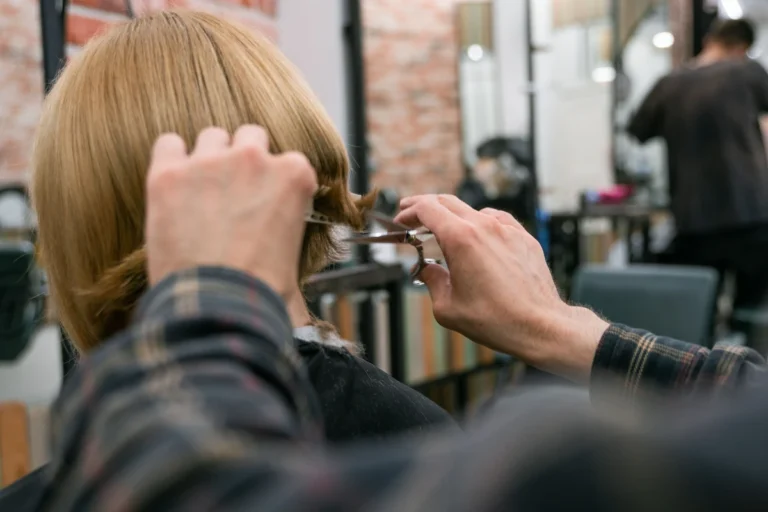
A textured bob uses point-cutting or razor work to break up the ends, creating piece-y, slightly uneven layers instead of one clean line.

The goal: Movement and a relaxed, lived-in finish that doesn’t require daily styling to look intentional.
Works well on:
- Thick or coarse hair, where texturizing removes bulk without losing length
- Wavy and curly hair, since broken ends let natural texture show instead of fighting it
- Anyone who air-dries most days or has a short morning styling window
Be careful with: Very fine, thin hair. Texturizing removes weight, and fine hair often doesn’t have much to spare — too much texture can leave ends looking sparse rather than soft.
Styling reality: This is the lower-maintenance option. A texture spray or light styling cream scrunched through damp hair is usually enough, and the cut is designed to look good without a blowout.
Face Shape Changes the Answer Too
Cut technique interacts with face shape, not just hair type:
- Oval and round faces often suit a blunt bob well — the straight line adds definition and a bit of structure without fighting the face’s natural proportions.
- Square and heart-shaped faces tend to look softer with a textured bob — the broken, piece-y ends counteract sharp angles instead of drawing a hard line right at the jaw.
For the full breakdown of which cuts, lengths, and bang styles work with your specific proportions, see our face shape haircut guide.
Maintenance: The Real Difference
This is where most people actually decide.
Blunt bob maintenance:
- Trim every 6–8 weeks — grown-out blunt lines look uneven faster than any other bob style
- Needs active styling most days (blow-dry, flat iron, or both) to keep the line sharp
- More vulnerable to visible split ends, since every strand is cut to the exact same length and shows wear evenly
Textured bob maintenance:
- Trim every 8–10 weeks — layers disguise regrowth better than a single clean line
- Works with minimal styling — texture product plus air-drying is often enough
- More forgiving of split ends, since the piece-y ends already look intentionally broken up
If heat styling is a regular part of your routine either way, our heat damage repair and prevention guide is worth reading before you commit. And if frizz is a concern with a textured cut specifically, see our frizz, humidity and porosity guide.
Can You Switch Between Them?
Yes, and it’s one of the easier haircut changes to make.
Going from blunt to textured: Your stylist can point-cut or razor the existing blunt line without losing much length. This is a common request for anyone who finds the daily styling demands of a blunt bob unsustainable.
Going from textured to blunt: This usually means trimming layers back up to a single length, which can mean losing a bit more length than you’d expect, since the shortest layers set the new baseline. If you’re not ready to lose length, ask your stylist about a “soft blunt” — a line that’s nearly one length but with the very ends lightly softened.
What to Say at the Salon
Bring this instead of just a photo — a picture alone doesn’t tell your stylist how much daily maintenance you’re actually willing to do:
“I want a [blunt / textured] bob. My hair is [fine/thick] and [straight/wavy/curly]. I usually style it by [blow-drying / air-drying], and I’ve got about [X] minutes most mornings. I’m trying to avoid [triangular shape / a line that looks unstyled by afternoon].”
That gives your stylist your hair type, your realistic styling window, and the specific problem you’re trying to avoid — which matters more than the reference photo itself.
Frequently Asked Questions
Which is more high-maintenance, a blunt bob or a textured bob?
A blunt bob is generally higher maintenance. It needs more frequent trims (every 6–8 weeks vs. 8–10) and more active daily styling to keep the line crisp.
Can I get a blunt bob if I have thick hair?
You can, but ask your stylist about internal layering that doesn’t show from the outside — this removes some bulk while keeping the visible line blunt, so the cut doesn’t end up looking triangular.
Is a textured bob good for fine hair?
Not usually the first choice. Texturizing removes weight, which fine hair often can’t spare. A blunt or very lightly textured bob tends to look fuller on fine hair.
Which one is better for curly hair?
A textured bob almost always works better on curly hair. Broken, layered ends let the curl pattern show and move naturally, while a blunt line tends to push curls outward into a triangular shape.
Do I have to choose one permanently?
No. You can move from blunt to textured relatively easily by point-cutting the existing line. Going the other way — textured to blunt — usually costs a bit more length, since the shortest layers set the new baseline.
Final Thoughts
Neither version is the “better” bob — they solve different problems. Blunt gives you density and a sharp, deliberate silhouette, at the cost of more frequent trims and more daily styling. Textured gives you movement and low-maintenance texture, at the cost of some of that crisp, graphic density.
Match the choice to your hair type, your face shape, and honestly, how much time you actually spend on your hair most mornings — not just the photo you saved.
Once you’ve picked a side, browse our full bob haircut guide for more variations within each style, or see layered haircuts if you want even more movement than a textured bob offers.



3 Comments