
12 Haircuts for Thin Hair That Look Fuller From Every Angle
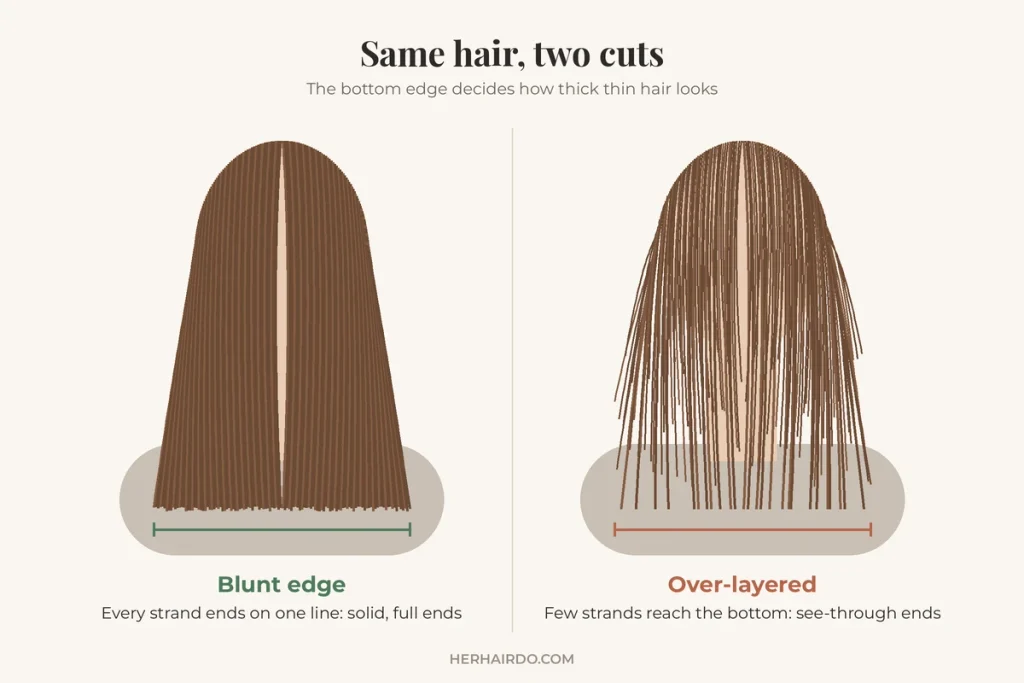
Ask a salon for “more volume” and most stylists reach for layers. On thin hair, that often backfires. Every layer moves hair away from the bottom edge, and the bottom edge is what tells the eye how thick your hair is. A see-through hemline reads as thin hair, no matter how much lift you build at the roots.
The cuts below start from the other end: a solid outline first, then movement only where it shows. They’re grouped by length, because length changes how much weight thin hair can carry. If you don’t know your face shape yet, run the face shape calculator first and keep the result handy as you read.
Fine, Thin or Thinning? A 30-Second Check
These three words get used as if they mean the same thing. They don’t, and each one changes which cut works best.
| Check | Fine hair | Thin (low-density) hair | Thinning hair |
|---|---|---|---|
| Roll one strand between your fingers | You can barely feel it | Feels average | Varies |
| Make a ponytail | Average size, but it slips out of elastics | Small; the elastic wraps three or more times | Smaller than it used to be |
| Look at your part under bright light | Little scalp shows | Scalp shows along the part | The part looks wider than a few months ago |
| What helps most | Lightweight products, blunt ends | Shorter lengths, solid outlines | A good cut for now, plus a dermatologist for the cause |
Many people have both fine strands and low density, and the cuts below suit that combination. If your hair is thinning (more shedding, a widening part, or patches), a haircut can make it look fuller, but it won’t change what’s happening at the scalp. A dermatologist can check the cause.
The Cut Rule for Thin Hair: Solid Edge, Light Inside
Thin hair looks thickest when the perimeter, the outer line of the cut, stays blunt. Movement comes from layers placed where they don’t thin out that line: inside the haircut (internal layers cut under the top section) or around the face only. The ends can be point-cut lightly to soften a hard line, but they shouldn’t be thinned out.
That’s the same idea behind the blended elevation cut in our layered haircuts guide: lift from the inside, weight kept at the bottom.
Short Cuts (Ears to Jaw)
1. Textured Pixie With Crown Height
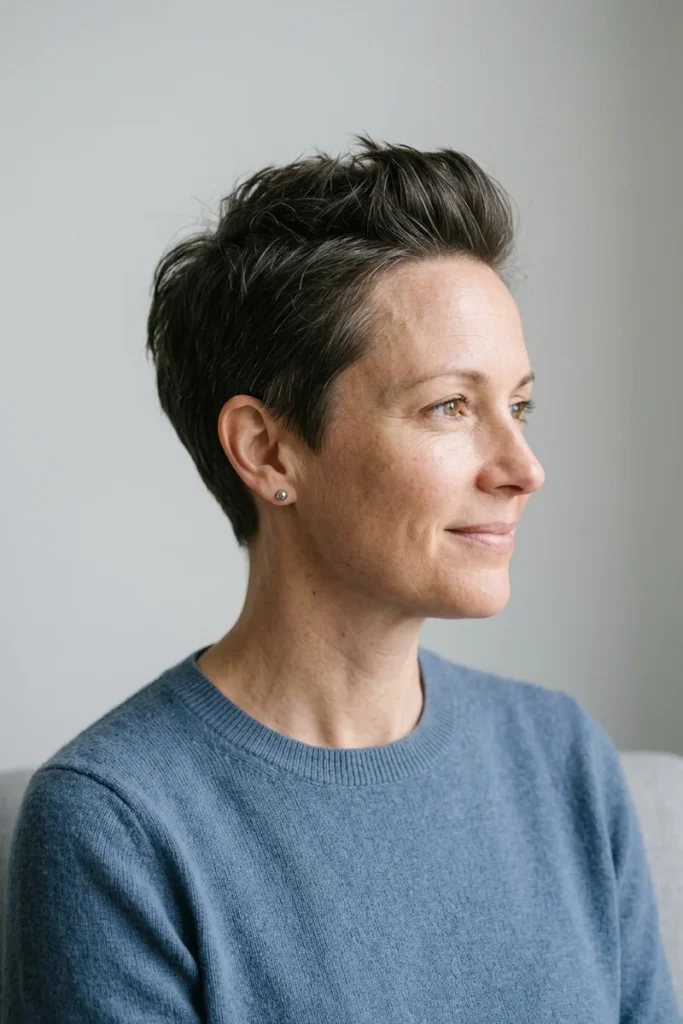
Short hair weighs less, so fine strands stand up instead of lying flat against the head. Keep the sides and nape close, leave two to three inches on top, and ask for texture on the top section only. The contrast between a neat outline and a lifted crown makes the whole head of hair look denser.
For pixie versions matched to face shape, see our pixie cut guide
Fullness tip: Work mousse into damp roots, then blow-dry the top forward first and back second. The roots set upright instead of flat.
2. Bixie With a Blunt Perimeter
The bixie sits between a pixie and a bob, anywhere from mid-ear to jaw. On thin hair, the outer line around the ears and jaw should stay solid, with any texture kept to the top. It’s a good landing spot if you’re growing out a pixie, or if a full bob feels like too much hair to manage.
Fullness tip: Ask for the back to sit slightly shorter than the front. A long, thin nape is the first spot that looks sparse.
3. Short Stacked Bob
Fine hair goes flattest at the back of the head. Graduated, stacked layers at the nape build a curve there, while the front stays near chin length. The modern version uses softer stacking than the rounded helmet shape many people remember, so it looks lifted rather than set.
Fullness tip: Dry the back first with a round brush at the crown, then do the front. If the front dries first, the back has nothing left to lift against.
Chin to Shoulder (The Fullest-Looking Range)
Most thin hair looks thickest in this range. It’s long enough to move and short enough that the ends keep their weight.
4. Blunt Chin-Length Bob
If one cut has to carry thin hair, this is it. One length, cut at or just below the chin, with the line checked once the hair is dry so it sits crisp. Because every strand ends at the same spot, the hemline looks twice as thick as the same hair worn long. Our bob haircut ideas show how far this shape can stretch, from sleek to wavy.
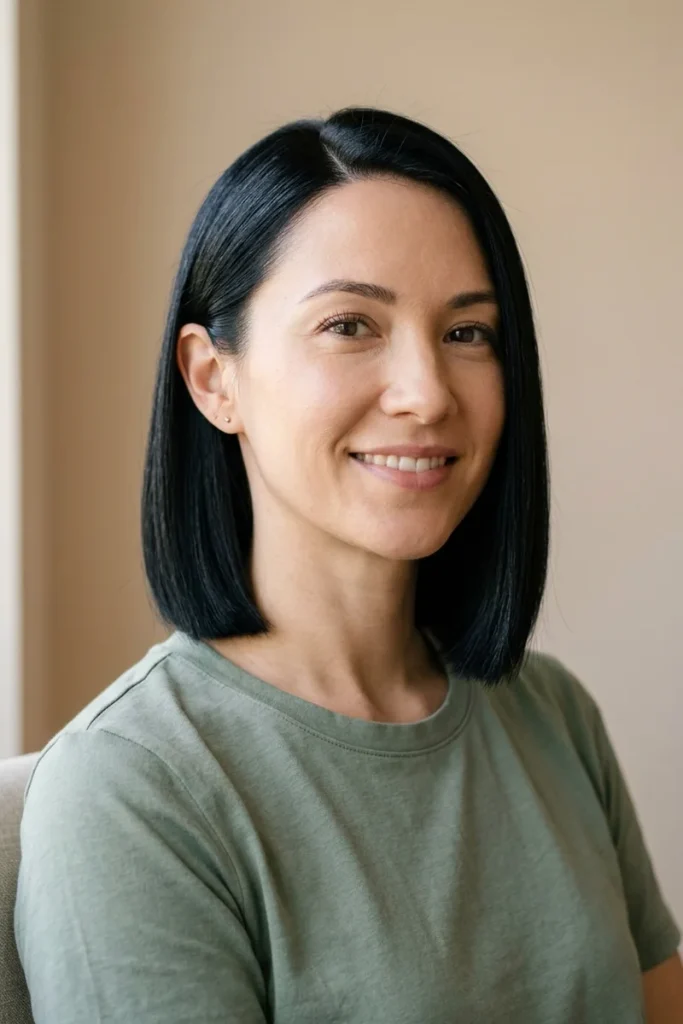
A quick way to style it:
- Rough-dry until almost dry.
- Finish with a flat paddle brush to smooth the outline.
- Bend the ends slightly under with a flat iron, or leave them straight for a sharper look.
Fullness tip: Tuck one side behind your ear. It shows off the thickness of the cut edge on the other side.
5. French Bob With Brow-Skimming Bangs
A French bob sits between the cheekbone and chin, paired with bangs at the brows. Bangs hide a sparse front hairline and pull attention to the eyes. The catch: bangs borrow hair from the rest of the cut. On thin hair, keep the bang section narrow and shallow, cut from just the front of the hairline, so the sides don’t lose density.

Fullness tip: Dry your bangs first, right after washing. Brush them side to side as you dry, then let them fall. They’ll sit fuller than if they air-dry flat.
6. Blunt Lob With Invisible Layers
The lob falls between chin and shoulders. For thin hair, the stylist cuts short layers underneath the top section of hair, where you can’t see them. Those hidden layers push the top layer up and out, while the outside still reads as one solid line. You get the bounce of a layered cut without the thin ends.

Fullness tip: Use the words “internal layers” at the salon. Many stylists know the technique, but it rarely gets offered unless you name it.
7. Angled (A-Line) Bob
An A-line bob is shorter at the back and longer at the front. That puts the weight around your face, where people look, and keeps the back short enough that it never looks sparse. It suits straight fine hair especially well. On very thin hair, keep the angle gentle (about an inch from back to front), because steep, long front pieces can turn stringy.
Fullness tip: Part on the side instead of the center. The deeper side gets extra volume and covers more of the scalp.
8. Soft Shag, Light on Layers
A classic shag removes a lot of weight, which can turn thin hair wispy. The fine-hair version keeps layers at the crown and around the face, and leaves the lower length fuller. You still get the shag’s tousled shape, just with ends that hold together. See the fine-hair section of our shag haircuts guide for more. For a choppier short option, the soft wolf cut in our short wolf cut ideas keeps the outline full on fine hair.
Fullness tip: Mist texturizing spray onto dry hair and scrunch. Heavy creams weigh shag layers down and separate them into strands.
9. Collarbone Cut With Curtain Bangs
Curtain bangs create movement at the front using very little hair, which makes them one of the better bang styles for fine hair. Paired with a one-length cut at the collarbone, the face gets framed and the ends stay full. The fine-hair version is cut lighter and slightly longer than standard curtain bangs. See style #12 in our curtain bangs guide

Fullness tip: Roll each side of your bangs around a medium round brush, away from your face, while drying. They’ll curve open instead of hanging flat.
Long Cuts (Without See-Through Ends)
Long thin hair can look good. The risk is the bottom inch. The longer hair grows, the older and more worn the ends are, and on low-density hair they turn see-through first.
10. Long Hair With a Blunt Hemline
Keep the length one line, and add face-framing pieces only from about the cheekbone down. Hold the ends up to a window: if you can see light through the bottom inch, the length has gone past what your hair can carry. Take it up until the hemline looks solid. For most thin hair, that’s somewhere between just below the shoulders and the bra strap.
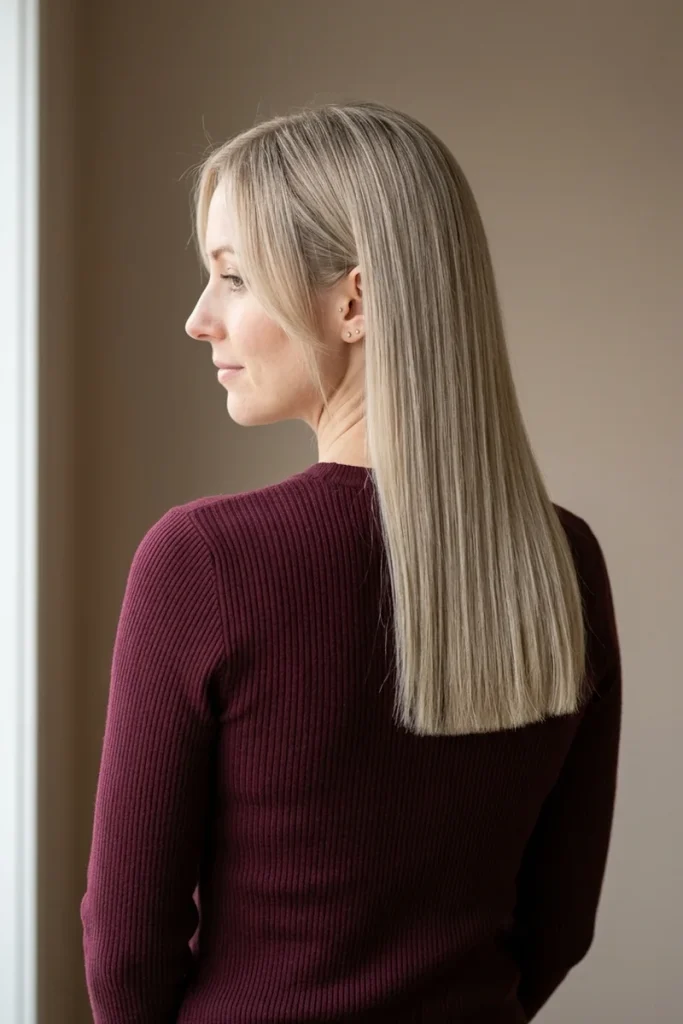
Fullness tip: Ask for the face-framing pieces to start no higher than your cheekbone. Pieces starting higher take too much hair from the front.
11. Long Layers Kept Low
If you want layers on long hair, keep them in the bottom few inches, starting well below the chin. The top stays full, and the ends get movement without losing their outline. Our layered haircuts by length guide shows how the same layers behave at each length.
Fullness tip: For no-heat waves, loosely braid damp hair in two or three sections overnight with lightweight mousse or texturizing spray. Skip creams and butters, which flatten fine hair.
12. Rounded Dry Cut for Wavy or Curly Fine Hair
Fine curls tend to clump into a few large ringlets, which leaves gaps that show the scalp. A dry cut, done curl by curl, lets the stylist build a rounded shape and spread the curls more evenly. Shoulder length or a little shorter usually gives the fullest result. Match products to your curl type with our curly hairstyles by curl type guide.
Fullness tip: Shape curls while wet, diffuse, and don’t touch them until fully dry. Heavy products made for Type 4 hair weigh fine Type 2 waves down.
Cuts and Techniques to Skip
| Skip this | Why it hurts thin hair | Ask for this instead |
|---|---|---|
| Thinning shears on the ends | Removes bulk from the one area thin hair needs it | Light point-cutting to soften the line |
| Heavy razor cutting | Tapers every end to a point; fine ends look wispy and fray faster | Scissor cut, with the razor only on face-framing pieces, if at all |
| Short layers all over | Leaves few strands at full length, so the hemline gets thin | Internal layers or face-framing only |
| One length far past the bra strap | Ends lose density as they age | A shorter one-length cut, or long layers kept low |
| Choppy, piece-y texturizing everywhere | Splits hair into separate strands and shows the scalp | A smooth outline with texture on top only |
What to Tell Your Stylist
Copy these lines to your phone and read them out at your appointment:
- “My hair is fine and low-density. I want the ends to look fuller.”
- “Please keep the perimeter blunt. No thinning shears or razor on the ends.”
- “If you add layers, keep them internal or around my face only.”
- “Can we check the line once my hair is dry?”
Bring photos of someone whose hair looks as thin as yours. A cut photographed on thick hair won’t look the same on yours. Straight fine hair can be cut wet and refined dry; wavy and curly fine hair usually do better with a dry cut.
Color That Adds Depth
One flat shade lets light pass straight through thin hair. Two or three close shades create shadow, and shadow reads as depth. A few lowlights under lighter pieces are the simplest version. Strong contrast between your hair and scalp makes a part look wider, so ask your colorist to soften the root area if your part shows. Fine hair breaks more easily after bleach, so keep any lightening to fewer, finer pieces. For shades matched to your undertone, see our hair color ideas.
A 5-Minute Volume Routine
- Shampoo the roots; condition only from mid-length to ends.
- Towel-dry, then apply heat protectant to damp (not soaking) hair and a small amount of mousse at the roots.
- Rough-dry with your head upside down, or against your growth direction, until about 80% dry.
- Finish the crown and front with a round brush.
- Flip your part to the opposite side now and then. Roots lift where they haven’t been trained to lie flat.
On day two, use dry shampoo at the roots before they look oily, not after. Match the dryer heat to your hair thickness. Our heat damage guide explains why fine hair needs lower settings.
How Often to Trim Thin Hair
Split ends show sooner on thin hair, so lean toward the shorter end of each range: pixies every 4–6 weeks, blunt bobs every 6–8, long layers every 8–10, curly cuts every 8–12, and long one-length hair every 10–12. A dusting (a quarter inch or less) keeps the hemline solid without losing length. The full breakdown is in how often to trim your hair.
FAQ
Are layers good or bad for thin hair?
It depends where they go. Layers inside the cut or around the face add movement without thinning the ends. Layers spread all over, especially short ones, take weight from the hemline and make thin hair look thinner.
What length makes thin hair look thickest?
For most people, between the chin and the shoulders. The ends keep their weight there, and the hair is still long enough to move.
Do bangs make thin hair look thinner?
Only when the bang section is wide or deep, because it takes too much hair from the sides. Narrow brow bangs or light curtain bangs add fullness at the front instead.
Is a bob or a pixie better for fine hair?
A pixie suits very fine hair that won’t hold any shape at length, since short strands lift more easily. A bob suits low-density hair when you still want hair around your face. Both work best with a solid outline.
What’s the best haircut for thin hair over 50?
The same rule applies: a blunt edge with lift at the crown. Hair often gets finer with age, so shorter cuts with crown height usually help. See our bob haircuts for women over 50 and pixie cuts for women over 50 for age-specific options.
Bottom Line
Thin hair looks fuller when the edge stays solid and the movement stays inside or around the face. Choose a length your ends can carry, ask for internal layers by name, and trim before the hemline turns see-through.