
Face Shape Calculator: What Is My Face Shape?
This face shape calculator works out your shape from four measurements, or from four quick mirror questions if you don’t have a tape measure. Add your hair texture and the length you like, and it suggests haircuts, bangs and color placement that suit your proportions.
Free tool · 60 seconds
What Is My Face Shape?
Measure your face or answer four quick questions. Get your shape, the cuts and bangs that suit it, and where to place color.
1Your measurements
Pull your hair back and look straight ahead. A soft tape works best; a string and a ruler work too.
1Look in the mirror
Hair pulled back, face straight on. Go with your first impression.
Which part of your face is the widest?
How long is your face compared with its width?
2Jaw and chin
These two answers separate shapes that measure alike, like round and square.
The corners of your jaw are…
Your chin is…
3Your hair
So the cut ideas fit your texture, not just your outline.
Texture
Length you want to wear
Do you wear glasses?
4Hair color matchOptional
Hair color suits your skin’s undertone, not your face shape. In daylight, check the veins on your inner wrist.
Your face shape
Haircuts to try
Bangs
Go easy on
Where to place color
Glasses
Read next
Your answers stay in your browser. Nothing is saved or sent anywhere.
How to Measure Your Face
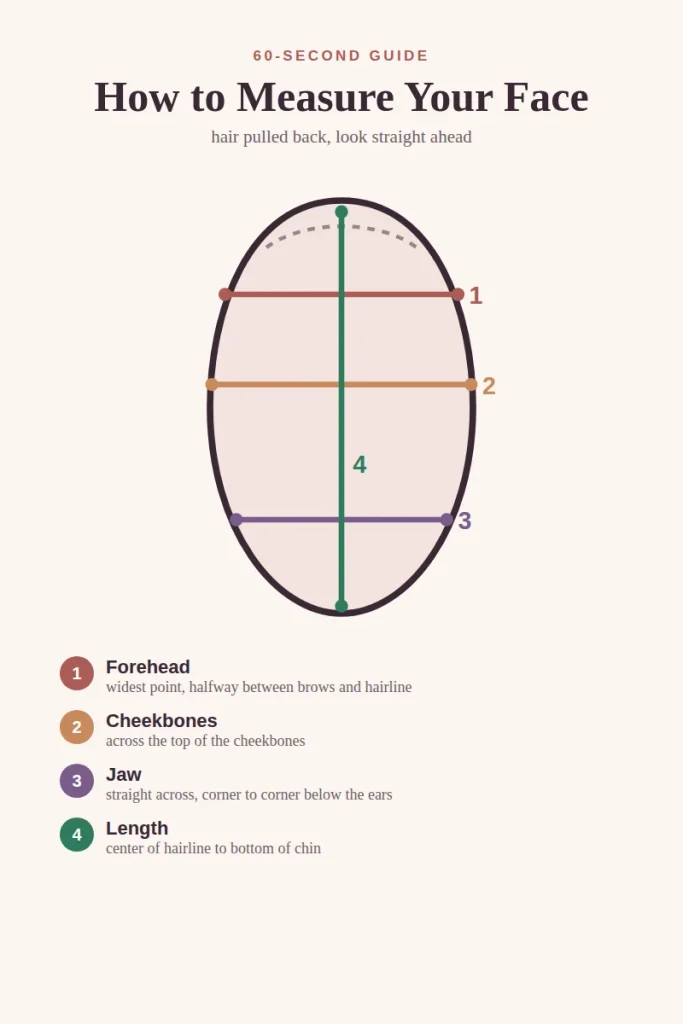
Pull your hair back with a headband or clips so you can see your full outline. Stand in front of a mirror, look straight ahead and keep your face relaxed. A soft sewing tape works best. A piece of string marked with a pen and laid against a ruler works too.
- Forehead: measure across the widest point, roughly halfway between your eyebrows and your hairline.
- Cheekbones: measure straight across the top of the cheekbones, just below the outer corners of the eyes.
- Jaw: measure straight across from one jaw corner, just below the ear, to the other.
- Face length: measure from the center of your hairline down to the bottom of your chin.
Use the same unit for all four, and measure each one twice. A difference of half a centimeter can tip a borderline result, so take the average if the two readings differ.
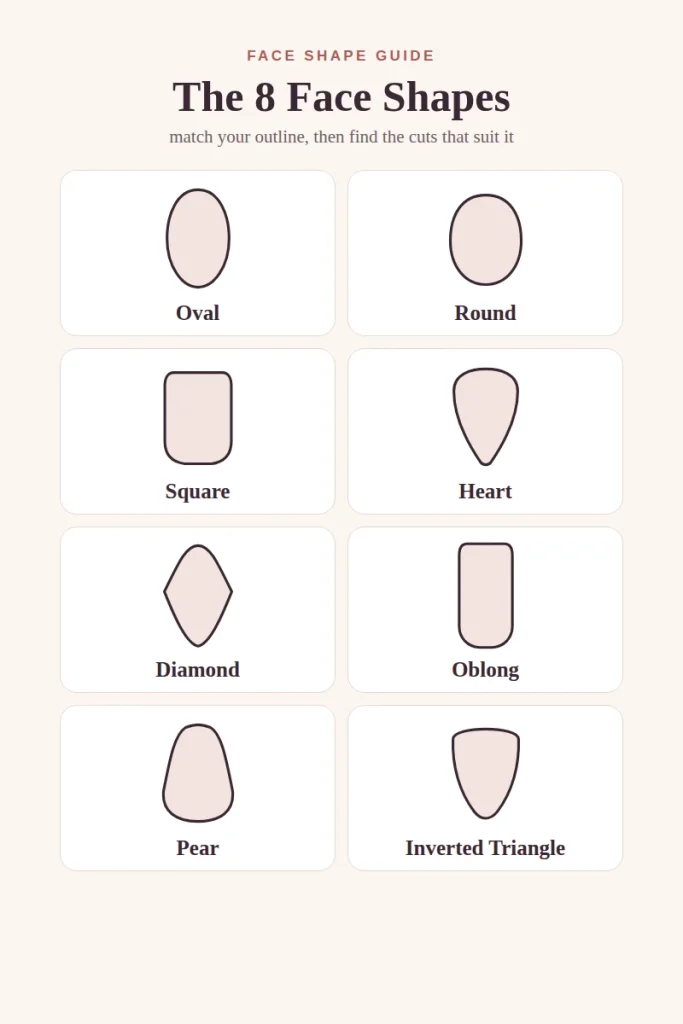
The 8 Face Shapes at a Glance
| Face shape | How it measures | One quick hair tip |
|---|---|---|
| Oval | Longer than wide, cheekbones widest, chin softly curved | Almost any cut works; add layers if you wear it very long |
| Round | Length and width close to equal, cheeks widest, no jaw angle | Build height at the crown, not volume at the sides |
| Square | Forehead, cheekbones and jaw similar, defined jaw corners | Keep blunt ends away from jaw level |
| Heart | Forehead widest, chin narrow and pointed | Put fullness in the lower half of the hair |
| Diamond | Cheekbones clearly widest, narrow forehead and jaw | Add width at the forehead with bangs |
| Oblong | Clearly longer than wide, straight sides | Bangs and side volume shorten the face |
| Pear | Jaw widest, forehead narrowest | Height at the crown, nothing heavy at the jaw |
| Inverted Triangle | Forehead wide, jaw tapering softly to the chin | Add weight around chin level and below |
For the full list of cuts for each shape, including what to say at the salon, see our guide on how to choose a haircut for your face shape.
Why the Calculator Asks About Your Jaw and Chin
Measurements alone can’t separate some shapes. A round face and a square face can have almost identical numbers: similar width at the forehead, cheekbones and jaw, and a short length. The difference is the jaw. A square face has sharp, defined corners and a round face has a soft curve.
Heart and inverted triangle faces have the same problem. Both are widest at the forehead. On a heart face the chin narrows to a point, while an inverted triangle tapers more gently to a rounder chin. Those two answers often change the result more than the tape measure does.
What If You’re Between Two Shapes?
If the calculator says you’re close to a second shape, that’s normal. Combinations like oval-heart and round-square are very common. Don’t try to follow both lists. Pick the feature you most want to balance, such as a strong jaw or a wide forehead, and choose cuts for that shape.
Does Hair Color Depend on Your Face Shape?
The shade that suits you depends on your skin’s undertone, not your face shape. That’s why the calculator asks about the veins on your wrist: greenish veins usually mean a warm undertone, blue or purple veins a cool one, and a mix means neutral. Our guide to hair color ideas for your undertone goes deeper into each one.
Face shape does decide where lighter and darker color looks best. Lighter shades draw the eye and add visual width, while deeper shades recede. A heart-shaped face looks balanced with brighter pieces near the jaw. A round face benefits from face-framing highlights that start below the cheekbone and run downward.
FAQ
Which face shape is the most common?
Oval is the shape most charts treat as the balanced one, but many people are a combination of two shapes. Your own measurements matter more than which shape is most common.
How accurate is a face shape calculator?
It’s as accurate as your measurements. Pull your hair fully back, measure twice and use the same unit for every number. If the result surprises you, check the jaw and chin answers too, since they change the result more than people expect.
Can your face shape change?
Your bone structure stays the same, but weight changes and age can soften the jaw and cheeks. A face that measured square at 25 can read closer to round or oval later on, so it’s worth checking again every few years.
Can I find my face shape from a photo?
Yes, roughly. Take a straight-on photo at eye level with your hair pulled back and even lighting, then use the quiz option and judge your outline rather than your features. A tape measure gives a more reliable result.
Do I need to know my face shape to choose a haircut?
It helps, but it’s one filter of three. Your hair texture and how much time you spend styling matter just as much. That’s why the calculator also asks about your texture and preferred length.
Final Thoughts
Your face shape is a starting point, not a rulebook. Use the result to choose where you want length, volume and color, then match it to your texture. If bangs are on your list, our guide to curtain bangs for every face shape shows which length to ask for.