
Curly Hairstyles Sorted by Curl Type, From 2A Waves to 4C Coils
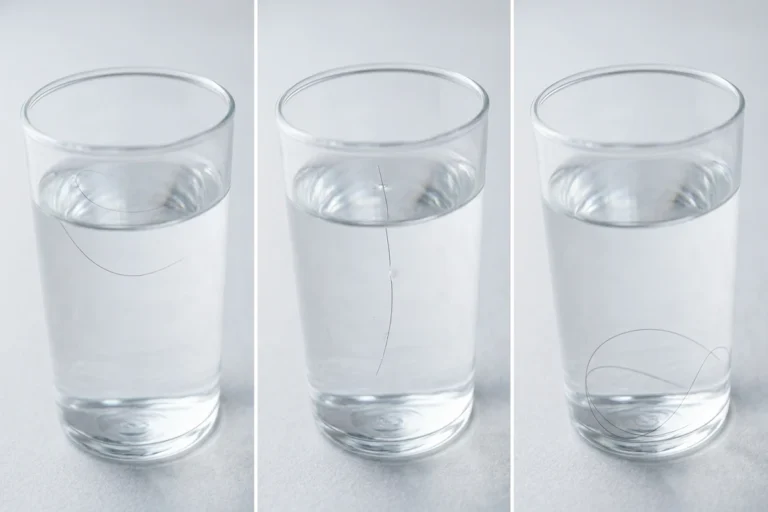
Take one clean strand of hair, with no product in it, wet it and let it hang. If it falls in a loose S, your hair is wavy (Type 2). If it forms a springy spiral you could wrap around a pencil or a straw, it is curly (Type 3). If it coils tightly or bends in a zigzag and shrinks a lot as it dries, it is coily (Type 4).
That one check decides more about your curly hairstyles than any photo will, because each type needs different products and a different way of styling. Most heads have more than one pattern, often looser at the crown and tighter underneath, so go by the pattern covering most of your hair. Porosity matters too; our frizz and porosity guide explains why two people with the same pattern can need different routines.
The Three Curl Types at a Glance
| Type 2: wavy | Type 3: curly | Type 4: coily | |
|---|---|---|---|
| Shape | Loose S-waves | Springy spirals | Tight coils or zigzags |
| Shrinkage | Little | Moderate | A lot, often 50% or more |
| Main problem | Goes flat, loses its wave | Frizz and curls separating | Dryness and breakage |
| Product weight | Light: mousse, spray | Medium: cream and gel | Rich: leave-in, oil, cream or butter |
| Wash | Every 2–3 days | Every 3–5 days | About once a week |
Type 2: Wavy Hair (2A, 2B, 2C)
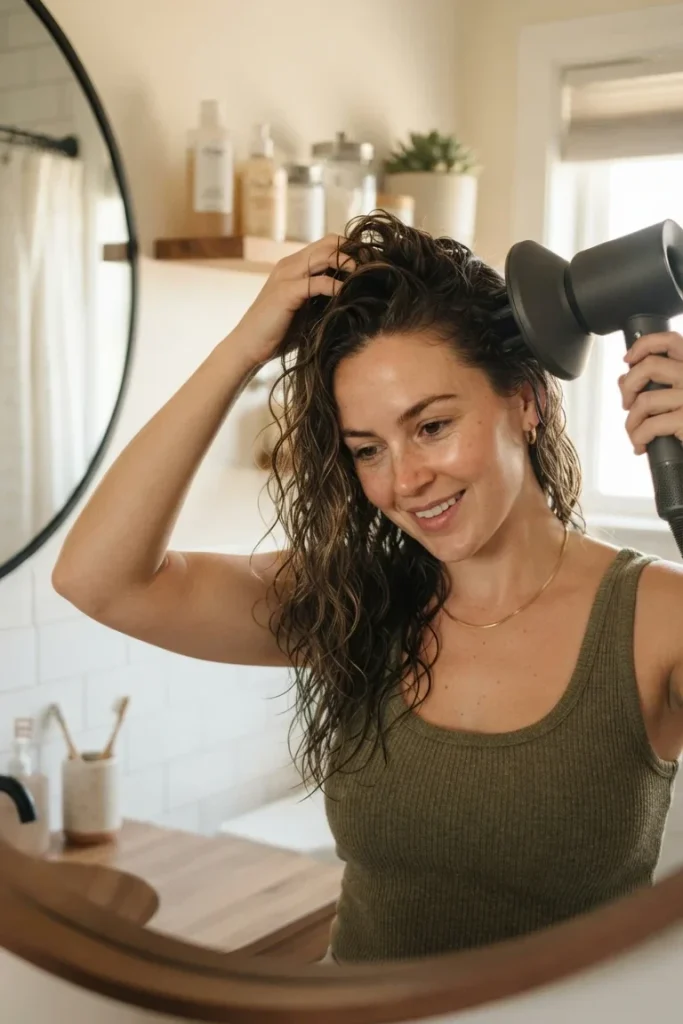
A wave is not strong enough to hold its shape under weight, so wavy hair needs light products and lift at the roots. Heavy creams and butters, made for coilier hair, flatten it.
Wash-day routine:
- Wash and condition; rinse conditioner well.
- On soaking-wet hair, rake through a light mousse.
- Scrunch upward from the ends to encourage the waves to clump.
- Diffuse on low heat or air-dry without touching.
- Once dry, scrunch out any stiffness from the product.
1. Scrunch-and-Diffuse
The most reliable technique for 2A and 2B hair. Cup sections of hair in the diffuser bowl, hold for a few seconds and release, on low heat. The waves clump without being weighed down.
2. Sea Salt Texture
For 2B and 2C hair with some natural bend. Spray onto damp hair and air-dry; the slight grit helps waves hold together instead of separating into frizz.
3. Root-Clipped Waves
Fine wavy hair often ends up flat at the crown with waves only at the ends. Clip sections up at the roots while drying and take the clips out once fully dry.
4. Half-Up Wave Twist
Twist two small front sections back and pin them, leaving the waves loose. 2C hair holds the twist without extra product.
5. Overnight Braid Waves
Loosely braid damp hair into two or three braids before bed and undo them in the morning. It gives soft waves to hair too fine to hold a diffused shape. Our easy braided hairstyles cover the braids.
Type 3: Curly Hair (3A, 3B, 3C)

Type 3 curls have the most bounce, but they react most to humidity and handling. They often look best on wash day and frizzy by day three, because every touch separates the clumps a little more.
Wash-day routine:
- Detangle only in the shower, with conditioner in, using fingers or a wide-tooth comb.
- On soaking-wet hair, smooth curl cream down each section between flat palms (the “praying hands” method).
- Scrunch in a light-hold gel.
- Plop: wrap hair in a microfiber towel or cotton T-shirt for 10 to 20 minutes.
- Air-dry or diffuse without touching. Once dry, scrunch out the gel’s crunch.
6. Praying-Hands Wash-and-Go
Gliding product down with flat palms keeps curls clumped together instead of splitting into single frizzy strands, which is what makes curls look like they have faded.
7. Plopped Curls
Plopping removes water without the rubbing that breaks curl clumps apart. Ten to twenty minutes is enough; longer can flatten the roots.
8. Curly High Puff
Gather curls at the crown with a soft scrunchie, leaving a few front curls loose. Good for 3B and 3C hair on day two or three, when the roots need lift but the ends are still defined.
9. Front Twist-Back
Twist the front curls back off the face and pin them, leaving the rest as a wash-and-go. It stops curls falling into your eyes all day.
10. Pineapple for Sleep
Gather curls loosely at the very top of the head with a silk scrunchie before bed, so you do not sleep on them. In the daytime, a satin-lined beanie does a similar job; see our guide to hats and beanies over curls.
11. Day-Three Refresh
Mist sections with water mixed with a little leave-in conditioner and re-twist or scrunch them. It revives the clumps without a full wash.
Type 4: Coily Hair (4A, 4B, 4C)
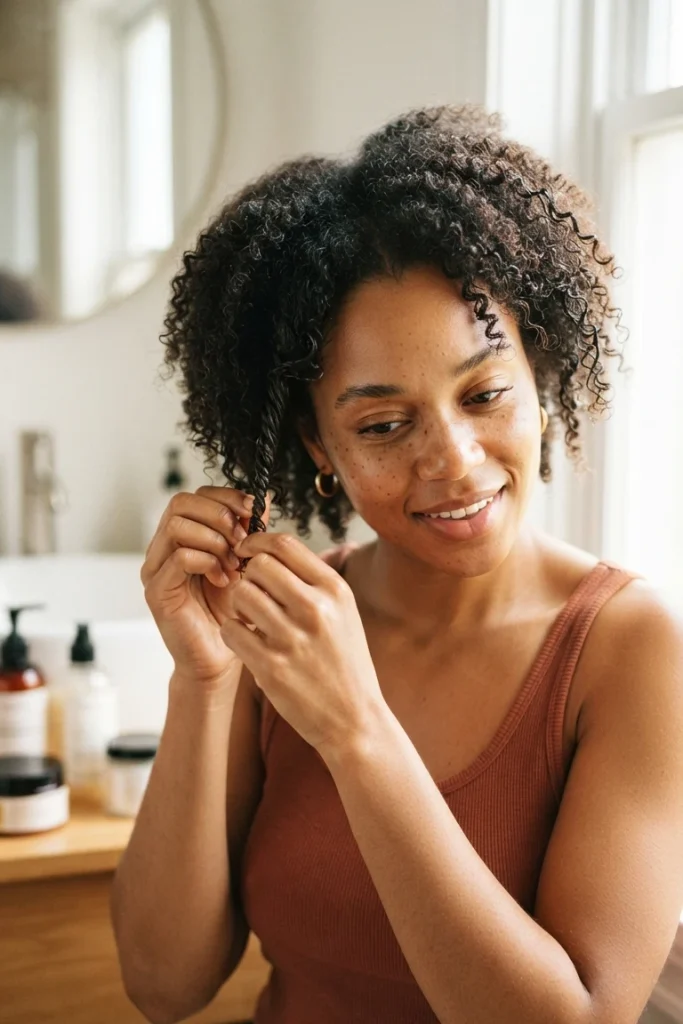
Coily hair shrinks the most, and natural oil has the furthest to travel from the scalp to the ends, so keeping moisture in matters more than the style itself. Coils are also the most fragile pattern, so work on damp hair in sections and handle it as little as possible.
Wash-day routine (LOC method):
- Detangle in sections with conditioner in, starting at the ends.
- Liquid: a water-based leave-in on damp hair.
- Oil: a light oil to seal the moisture in.
- Cream: a curl cream or butter to define and hold.
- Style in sections while damp, then let it dry completely.
Some hair does better with the cream before the oil (LCO). Try each for a couple of weeks and keep the one that leaves your hair softer for longer.
12. Twist-Out
Set two-strand twists on damp hair coated in product and undo them only when completely dry. Undoing them while even slightly damp makes the definition collapse.
13. Braid-Out
The same idea with three-strand braids, which give a looser, wavier pattern and more stretch. Good for 4A hair that wants length without tight coils. If you would rather wear the braids than take them out, our curly braided hairstyles keep the curly ends on show.
14. Bantu Knots
Small sections wound into knots against the head and released once dry. One of the few heat-free methods that defines even tight 4C hair.
15. Wash-and-Go With LOC Layers
Layering liquid, oil and cream before styling is the step most often skipped when a 4A to 4C wash-and-go looks dry within hours.
16. Flat Twist Updo
Flat twists against the head, gathered into a bun at the crown or nape. A protective style that can last up to a week with little daily handling; keep the twists comfortable, not tight, at the edges. Our box braids guide covers other protective styles.
17. Chunky Twist Half-Up
Four to six large twists at the crown, pinned back, with the rest worn loose. It adds shape without the time a full twist-out takes.
18. Finger Coils
Coil small sections around a finger with styling cream. Best on shorter 4B and 4C hair, where twist-outs unravel too quickly.
Mistakes to Avoid by Curl Type
| Curl type | Common mistake | Do this instead |
|---|---|---|
| 2A–2B | Heavy creams and butters | Light mousse or spray |
| 2C | No lift at the roots | Root clips while drying |
| 3A–3B | Brushing dry curls | Detangle wet, with conditioner |
| 3B–3C | Touching curls while they dry | Plop, then leave them alone |
| 4A–4B | Styling dry, unmoisturized hair | Style damp, after LOC layers |
| 4C | Undoing twists before fully dry | Wait, or dry under a hooded dryer on low |
FAQ
How often should curly hair be washed?
It depends on the pattern. Wavy hair often needs washing every two to three days, curly hair every three to five, and coily hair about once a week. Too often strips the oil curls need; too rarely leaves buildup that weighs them down.
Why do my curls frizz no matter what I do?
Usually one of three things: touching or brushing curls while they dry, not enough moisture (especially for 3C to 4C hair), or humidity. A gel cast that you scrunch out once dry, and less handling, fix most of it.
Can heat ruin my curl pattern?
Occasional diffusing on low heat is unlikely to cause lasting harm, but frequent high heat, such as daily flat-ironing, can weaken the hair and loosen the pattern over time. The American Academy of Dermatology suggests using the lowest heat setting when you do use heat. Our heat damage guide covers repair.
Do different curl types need different products?
Yes. Light mousses suit Type 2, curl creams and gels suit Type 3, and leave-ins, oils and butters suit Type 4. Using a Type 4 product on Type 2 hair, or the reverse, is the most common reason a routine fails.
Can I have more than one curl type?
Most people do. Style for the pattern that covers most of your head, and use a little extra product or a different technique on the sections that behave differently.
The Rule for Every Curl Type
Curls are shaped while wet, by water and product, not fixed once they are dry. Apply product to soaking-wet hair, let it dry without touching, and refresh with water rather than a brush. For cuts that suit each pattern, see our guides to shag haircuts and layered haircuts, and for up-styles, our half up half down hairstyles.