
Short Hairstyles for Round Faces: 14 Cuts That Add Length, Not Width
Short hairstyles for round faces work best when they add height and length instead of width. A round face is about as long as it is wide, with the fullest point at the cheeks and a soft jaw, so the cut that flatters it puts volume at the crown, keeps the sides close and avoids a hard line right at the cheeks or chin.
None of this is a rule you have to follow. Any cut can work if you like it. But if you want your face to look a little longer, the details below make the difference: where the ends fall, where you part your hair and what kind of bangs you choose. This guide covers fourteen cuts sorted by length, from pixies to lobs, with what to ask for at the salon.
Check Your Face Shape First
Many faces that look round in photos are oval or heart-shaped in real life. Measure before you choose: if your face length and cheekbone width are within about an inch of each other and your jaw is soft rather than angular, your face is round. Our face shape calculator does the math from four measurements.
What Makes a Round Face Look Longer
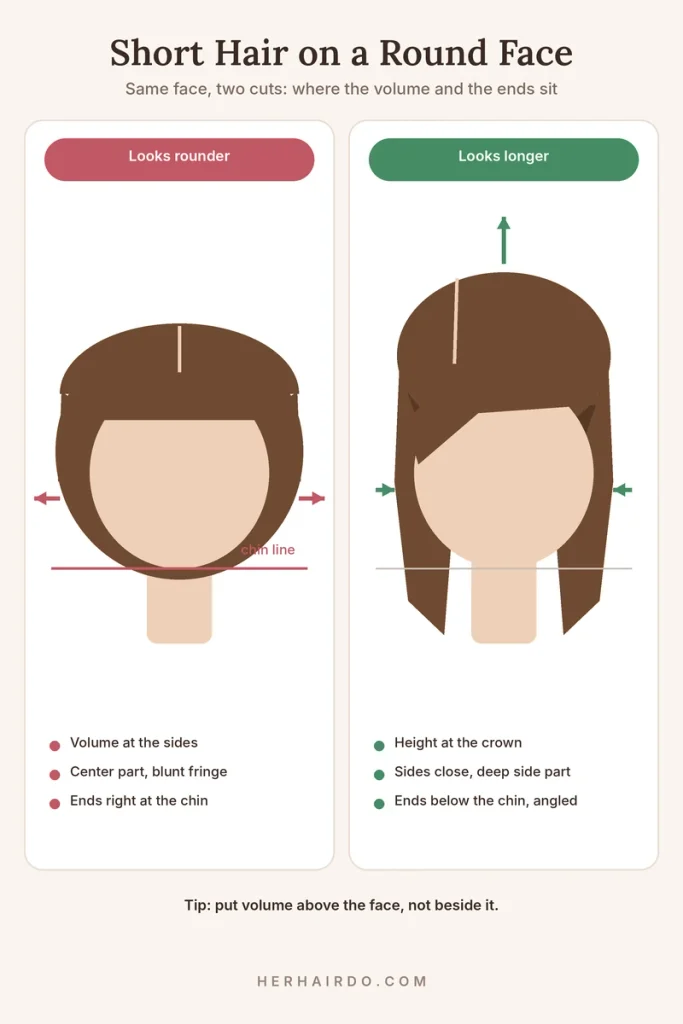
Five choices decide whether a short cut adds length or width. The diagram and table show the same idea from two sides.
| Choice | Makes the face look rounder | Makes the face look longer |
|---|---|---|
| Where the ends fall | Exactly at the cheeks or chin | Above the cheekbones or below the chin |
| Volume | At the sides, level with the cheeks | At the crown, with the sides kept close |
| Part | Center part on very short hair | Deep side part, which adds a diagonal line |
| Bangs | Heavy, blunt and straight across | Long, wispy or side-swept past the cheekbones |
| Shape of the cut | Rounded, one-length, curving under at the jaw | Angled, layered or asymmetrical |
Our guide to choosing a haircut for your face shape explains the same principle for all eight face shapes.
Pixie Cuts for Round Faces
1. Textured Pixie With Height on Top
The classic choice for a round face. The sides and back are cut close and tapered, while the top is left longer, about two to four inches, and point-cut for texture. Push the top up and slightly back with a little paste so the height sits at the crown, not at the sides. Our pixie cut guide explains how the top length changes the look.
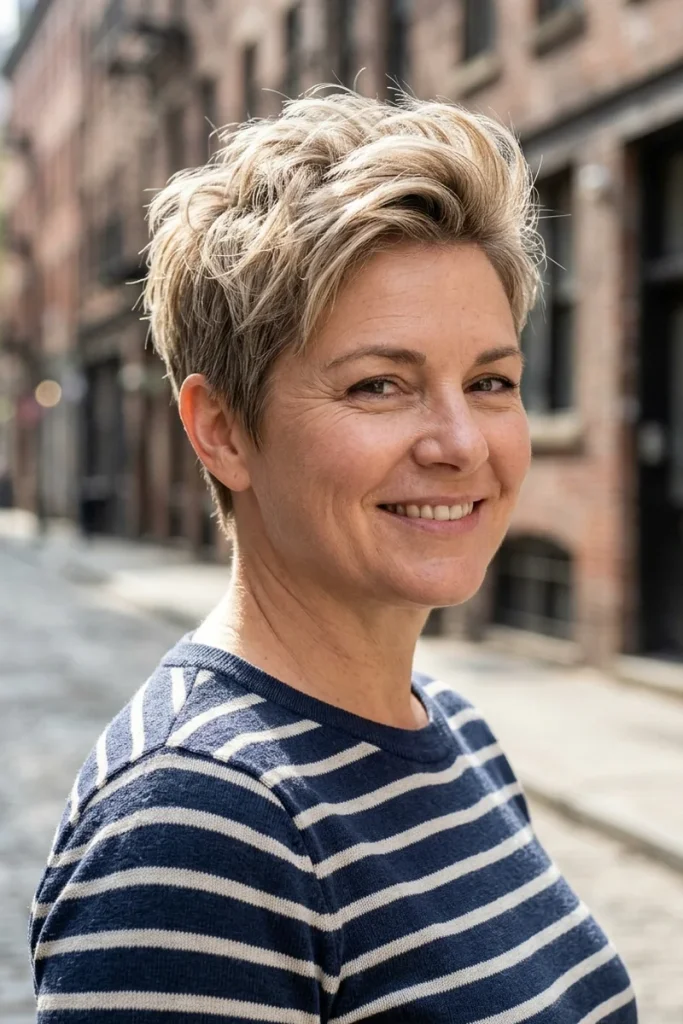
Why it works: All the volume sits above the face, which draws the eye up and makes the face look longer.
2. Long Side-Swept Pixie
A softer pixie with a longer fringe swept across the forehead to one side. The longest piece reaches the cheekbone or just past it and creates a diagonal line across the face. It suits anyone who wants a pixie but prefers some length around the face.
Why it works: The diagonal fringe breaks up the width of the face.
3. Asymmetrical Pixie
One side is cut close above the ear and the other is left longer, falling toward the jaw. The uneven line is the point: the eye follows the angle instead of the width of the cheeks. Wear it with a deep side part on the longer side.
Why it works: An asymmetrical outline stops the cut from echoing the round shape of the face.
4. Curly Pixie With Volume on Top
Curls add width quickly, so the sides of a curly pixie are kept shorter than the top. Ask for the cut to be done dry, curl by curl, so the stylist can see where each curl sits. The top is left longer for height. Our guide to curly hairstyles by curl type covers products for short curls.
Why it works: The curls stack upward rather than outward.
Ear to Chin Length
5. Asymmetrical Bob
A bob that is shorter on one side, often near the ear, and longer on the other, ending below the chin. The angle across the face does the slimming work. It looks sharp on straight hair and softer on waves.

Why it works: The longer side ends below the jaw, past the widest part of the face.
6. Bixie With Crown Lift
The bixie sits between a pixie and a bob: short, layered and textured, usually ending around the ears or upper neck. For a round face, ask for the layers to build height at the crown and for the sides to be thinned so they don’t puff out at the cheeks.
Why it works: It gives the height of a pixie with a little more coverage at the sides.
7. Short Choppy Shag
Short, choppy layers through the crown with longer, wispy pieces around the face. The texture breaks up a round outline, and the crown layers lift easily with a little texture spray. Ask for the face-framing pieces to fall below the cheekbones, not right on them. See our shag haircuts for how the length changes the look.
Why it works: Choppy layers create movement and vertical lines instead of a smooth, round outline.
Bobs That End Below the Chin
8. Angled A-Line Bob
Shorter at the back and longer at the front, with the front pieces ending an inch or two below the chin. The angle draws a line from the back of the neck down toward the collarbone, which lengthens the face. Keep the back stacked lightly for lift at the crown.
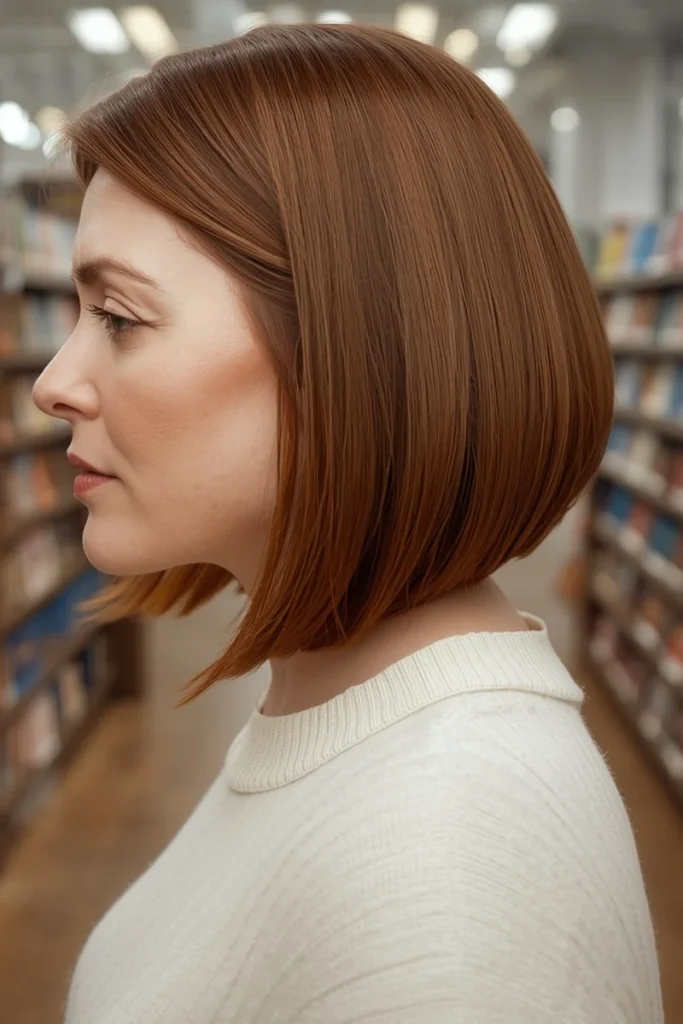
Why it works: The front pieces fall past the jaw and point downward.
9. Textured Bob With a Deep Side Part
A bob that ends just below the chin, with soft texture through the ends instead of a blunt line. Flip your part deep to one side so more hair falls across one cheek. Point-cut or slide-cut ends keep the bob from curving into a rounded shape at the jaw. Our comparison of blunt and textured bobs explains the difference in upkeep.
Why it works: The textured ends and the side part both break the round outline.
10. Stacked Inverted Bob
Layers are stacked at the back of the head to create lift, and the front is left longer. It works especially well on thick hair, because the stacking removes weight from the back and puts the volume at the crown, where a round face needs it.
Why it works: Height at the back of the crown lengthens the profile and the front view.
11. Bob With Long Curtain Bangs
A below-the-chin bob with curtain bangs that start at the brow and fall past the cheekbones. The bangs frame the face in two diagonal lines, which narrows the cheeks visually. Avoid short, blunt bangs with this cut. Our curtain bangs guide shows how long to ask for them.

Why it works: The bangs create vertical lines on both sides of the face.
Long Bobs (Lobs)
12. Angled Lob
A longer version of the A-line bob, ending around the collarbone at the front. It is the easiest short-to-medium cut for a round face, because the length already sits well below the jaw. Wear it straight with the ends bent slightly under, or with loose waves.
Why it works: The length draws the eye down past the widest part of the face.
13. Layered Lob With Face-Framing Pieces
A lob with long layers and face-framing pieces that start below the chin. The layers add movement, so the hair doesn’t sit as one solid block around the face. Our bob haircut guide explains how to choose a lob by hair texture.

Why it works: Face-framing pieces below the chin narrow the lower face.
14. Curly Lob With Long Layers
Curls at lob length can grow wide at the cheeks if the cut is one length. Long layers, cut dry, remove bulk from the sides and let the curls stack. Keep the shortest layer below the chin.
Why it works: Layering shifts the volume from the sides to the crown and ends.
Bangs for Round Faces
| Bangs | For a round face |
|---|---|
| Long curtain bangs | One of the best options; ask for them to fall past the cheekbones |
| Side-swept bangs | Good; the diagonal line breaks up width |
| Wispy, thin bangs | Good if they are light enough to show some forehead |
| Blunt, heavy bangs | Harder to wear; they cut the face in a horizontal line |
| Very short micro bangs | Usually add width; best avoided unless you love the look |
Short Hair for Round Faces by Hair Type
| Hair type | Best short cuts | What to watch |
|---|---|---|
| Fine or thin | Textured pixie, angled bob, bixie | Avoid heavy thinning, which makes fine hair look sparse; see our haircuts for thin hair |
| Thick | Stacked inverted bob, choppy shag | Ask for weight to be removed at the sides so they don’t puff out |
| Wavy | Textured bob, layered lob | Waves add width; keep the shortest layer below the chin |
| Curly or coily | Curly pixie, curly lob with long layers | Ask for a dry, curl-by-curl cut |
| Gray or silver | Textured pixie, angled bob | A little texture keeps short gray hair from looking flat; see pixie cuts for women over 50 |
What to Ask for at the Salon
Bring a photo, and use plain words the stylist can act on:
- “I’d like the volume at the crown and the sides kept close to my head.”
- “Please keep the ends above my cheekbones or below my chin, not right at them.”
- “Can we try a deep side part instead of a center part?”
- “If I have bangs, I’d like them long and wispy, falling past my cheekbones.”
- “I’d like the outline angled or textured, not rounded under at the jaw.”
Short cuts need regular trims to keep their shape: about every four to six weeks for a pixie and six to eight weeks for a bob. Our hair trim schedule lists timings for every cut.
Styling Short Hair on a Round Face
- Lift the crown. Blow-dry the top with your fingers or a round brush, lifting the roots up and back.
- Keep the sides smooth. Dry the sides flat against the head and point the nozzle down the hair.
- Bend the ends. On bobs, bend the front ends slightly forward and down rather than curling them under into a rounded shape.
- Finish with texture. A little paste or texture spray on the top keeps the height through the day.
Short Hairstyles for Round Faces FAQ
What short haircut is most flattering for a round face?
A textured pixie with height on top and an angled bob that ends below the chin are the most reliable short hairstyles for round faces. Both put volume at the crown and keep the sides close.
Should a round face have a center or side part?
A deep side part usually suits a round face better on short hair, because it creates a diagonal line. A center part can work on longer cuts like a lob, where the length below the chin already adds a vertical line.
Can I wear a chin-length bob with a round face?
Yes, but a blunt bob that ends exactly at the chin and curves under tends to repeat the round shape. An angled or textured bob that ends just below the chin is easier to wear.
Are bangs a good idea for a round face?
Long curtain bangs and side-swept bangs suit round faces well. Short, heavy, straight-across bangs are harder to wear because they add a horizontal line.
Will a pixie cut make my face look rounder?
Not if it has height on top. A pixie that is cut close all over can show more of the face’s roundness, but a pixie with a longer, textured top and close sides makes a round face look longer.
Picking Your Short Cut
The best short hairstyles for round faces share three traits: height at the crown, sides kept close, and ends that sit above the cheekbones or below the chin. Choose the length you like, from a textured pixie to an angled lob, then add a deep side part or long curtain bangs for a diagonal line. If you’re growing a short cut out later, our guide to growing out a bob walks through each stage.