
Haircuts for Thick Hair: 14 Cuts That Remove Weight Without Losing Shape
Thick hair has a reputation for being easy, until you are the one blow-drying it for forty minutes or watching a fresh bob turn into a triangle by week three. The best haircuts for thick hair are not about cutting it short. They are about where the stylist takes weight out, and how, so the hair keeps its fullness but stops puffing out at the sides or dragging flat at the roots.
This guide starts with a quick check of which kind of thick hair you have, explains the weight-removal techniques you will hear about in the salon, then covers 14 cuts by length and texture. If your hair is the opposite, see our haircuts for thin hair.
First, Which Kind of Thick Is It?
“Thick” describes two different things, and they need different cuts. Many people have one, some have both.
| Dense hair | Coarse hair | |
|---|---|---|
| What it means | Lots of strands on your head | Each strand is wide |
| Quick check | Your scalp is hard to see even at the part; a ponytail is wide around | A single strand feels like thread between your fingers, not silk |
| Main problem | Bulk and width, a “triangle” shape | Stiffness, frizz, slow drying |
| What helps | Removing weight from the inside | Moisture, weight at the ends to help it lie down, gentle texturizing |
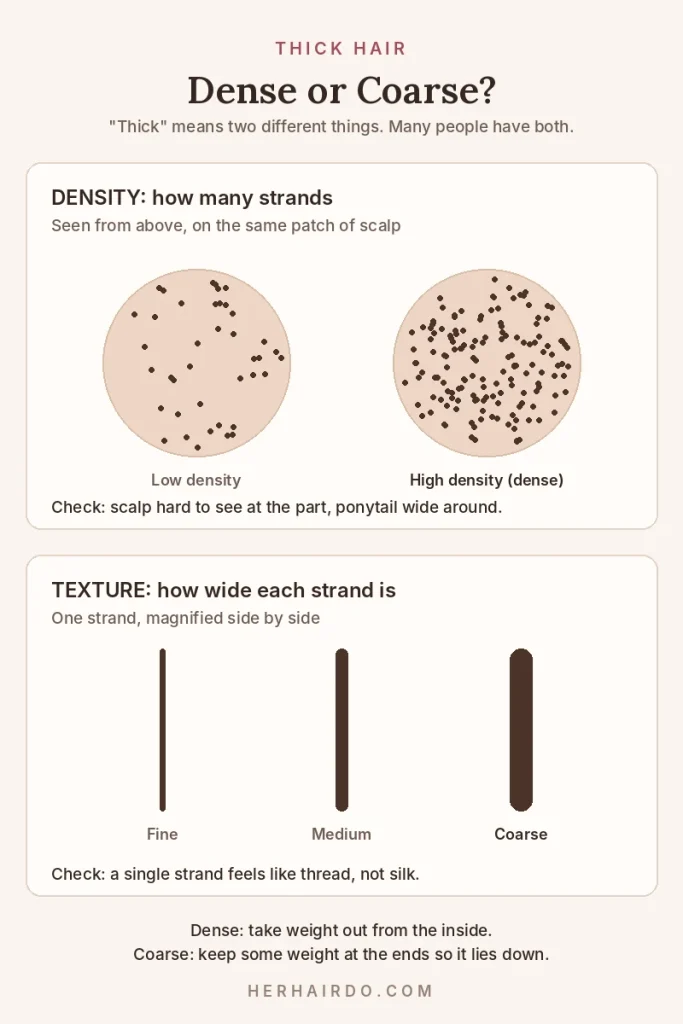
Dense but fine hair (many thin strands) is common too. It looks thick but can lose its shape if too much weight is taken out, so it needs a lighter touch than dense, coarse hair.
How Stylists Take Weight Out
You do not need to know how to do these, but knowing the names helps you ask for the right thing and say no to the wrong one.
| Technique | What it does | Good for | Be careful if |
|---|---|---|---|
| Internal (invisible) layers | Shorter pieces cut underneath, hidden by the top layer | Dense hair that should keep a clean outline | You want very visible layers |
| Point cutting | Snips into the ends at an angle to soften them | Any length; softening a blunt line | Your ends are already thin |
| Slide cutting | Open scissors slid down the mid-lengths to remove bulk | Straight and wavy dense hair | The hair is very fine at the ends |
| Channel or “carving” cuts | Thin channels of hair removed in heavy areas, often at the back | Very dense hair | Hair is short; channels can show |
| Thinning shears | Toothed shears that remove a share of the strands | Spot-thinning heavy areas, used sparingly | Hair is curly or frizz-prone; short pieces can puff up |
| Razor cutting | Shapes the ends with a razor for a soft, frayed finish | Straight and wavy hair | Hair is curly, coarse or damaged; ends can fuzz |
| Undercut | Hair shaved or clipped short at the nape or sides, hidden underneath | Very dense hair, short to medium cuts | You often wear your hair up and do not want it to show |
One common mistake is thinning the whole head. Ask for weight to come out only where the hair feels heavy, usually the back and sides around the ears, and never close to the root on curly hair.
Short Cuts
1. Tapered Pixie With a Textured Top
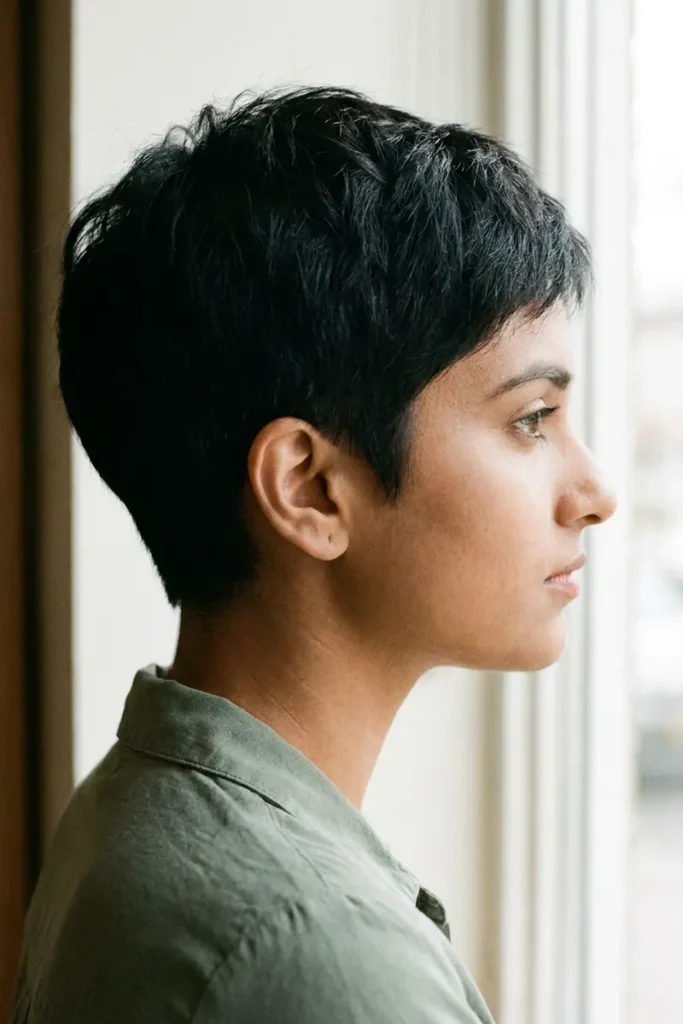
Close-tapered sides and nape with more length on top, broken up with point cutting so it does not sit like a helmet. Dense hair holds a pixie shape well, which makes it one of the easiest short cuts to wear. Our pixie cut guide matches pixie shapes to face shape and texture.
Weight comes out through: a tapered nape and sides, plus point cutting on top. Grows out: needs a trim every 4 to 6 weeks to keep the taper.
2. Short Bob With a Hidden Undercut
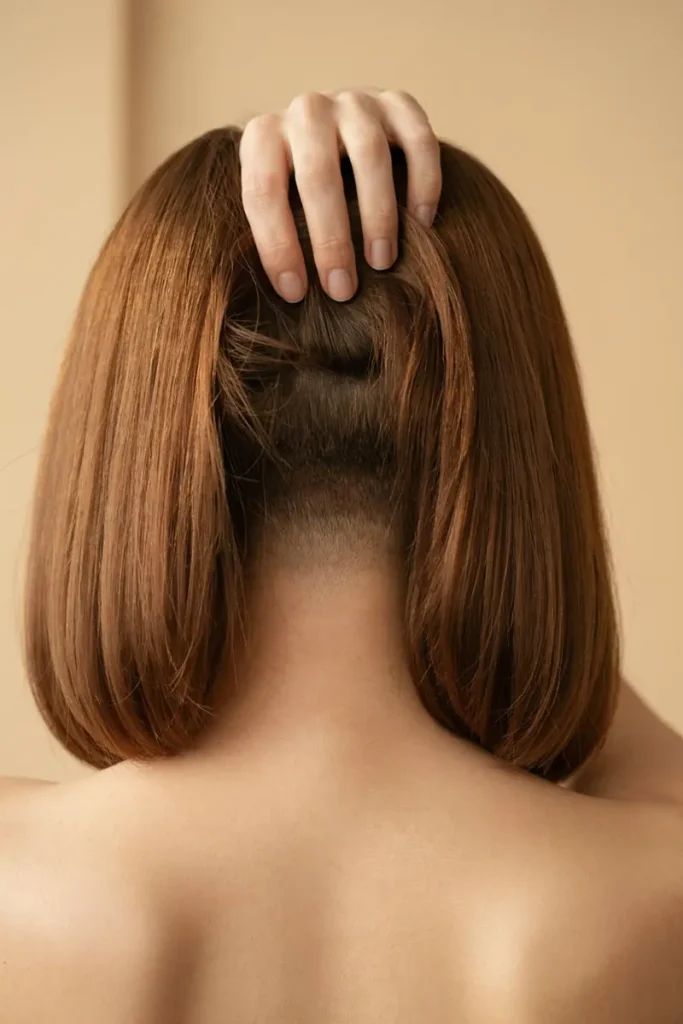
A chin-length bob with a small section clipped short at the nape, underneath. The bob keeps a clean, heavy line on the outside, but the back no longer bulges. When the hair is down, nobody can see the undercut.
Weight comes out through: a nape undercut. Grows out: the undercut needs a quick clean-up every 4 to 6 weeks; the bob every 6 to 8.
3. Textured Bixie
Between a pixie and a bob, around cheekbone to jaw length, layered all through. The layers give dense hair somewhere to go, so it moves instead of puffing out.
Weight comes out through: layers throughout and slide cutting. Grows out: grows into a short bob gracefully.
Medium Cuts
4. Blunt Lob With Internal Layers

A collarbone-length lob with a strong, blunt outline, but with shorter layers cut underneath. It is the best answer for people who like the look of a blunt cut but whose hair turns into a triangle with one. Our blunt vs textured bob comparison explains the difference in upkeep.
Weight comes out through: internal layers. Grows out: holds its shape for 8 to 10 weeks.
5. Shaggy Shoulder-Length Cut

Choppy layers all over, a little shorter at the crown. Thick hair is where a shag looks best, because there is enough hair to fill out every layer. See our shag haircuts for 21 variations.
Weight comes out through: layers throughout, point cutting and slide cutting. Grows out: looks good grown out a few extra weeks.
6. Collarbone Cut With Curtain Bangs
A soft collarbone length with long curtain bangs that blend into face-framing layers. The bangs take weight off the front, which is often the heaviest part of dense hair. Our curtain bangs guide covers lengths and styling.
Weight comes out through: face-framing layers and thinned-out bangs. Grows out: the bangs need a trim every 4 to 6 weeks.
7. Medium Layered Cut With a Side Part

Long, blended layers starting below the chin, worn with a deep side part. Flipping the part adds volume at the roots, which helps coarse hair that tends to lie heavy and flat on top. More ideas are in our hairstyles for medium length hair.
Weight comes out through: long layers and slide cutting. Grows out: grows out evenly; trim every 8 to 10 weeks.
Long Cuts
8. Long Layers With a V-Shaped Back

Long layers through the lengths and a back that comes to a soft V. The V takes weight off the outer edges at the back, so the hair falls narrower. Our layered haircuts by length guide explains how layer placement changes the shape.
Weight comes out through: long layers and a V perimeter. Grows out: very forgiving; trim every 10 to 12 weeks.
9. Long Cut With Face-Framing Layers
Long hair kept mostly one length, with shorter pieces only around the face. It is the gentlest change if you want to keep your length but stop the front from looking heavy.
Weight comes out through: face-framing layers only. Grows out: easy to grow; trim every 10 to 12 weeks.
10. Long Wolf Cut

A shorter, rounded crown over long, wispy lengths. It needs density at the crown to hold its shape, which thick hair has. Our wolf cut guide matches versions to hair type.
Weight comes out through: short crown layers and thinned ends. Grows out: the crown needs a trim every 6 to 8 weeks to keep the shape.
Curly, Coily and Coarse Hair
11. Rounded Curly Cut, Cut Dry

Shaped curl by curl while the hair is dry, with layers that take weight off the top so curls spring up instead of being pulled flat, and the sides kept slightly shorter so the shape does not widen at the bottom. Ask for no thinning shears. Our curly hairstyles by curl type cover care for each curl pattern.
Weight comes out through: curl-by-curl layering, cut dry. Grows out: looks good for 10 to 12 weeks.
12. Tapered Coily Cut
Shorter at the sides and nape, with more length and shape on top. Tapering removes bulk around the ears and neck, where dense coily hair tends to feel hottest and heaviest, and shows off the curl pattern on top.
Weight comes out through: a tapered nape and sides. Grows out: needs a shape-up every 4 to 8 weeks.
13. Long Coarse Hair With Blunt Ends and Light Layers
For coarse, straight or wavy hair that sticks out: keep a fairly blunt perimeter so the weight at the ends helps it lie down, and add only light, long layers. Too many short layers can make coarse hair stand out more. Our guide to frizz and porosity covers the products that help it stay smooth.
Weight comes out through: light long layers, with the ends left heavy. Grows out: easy; trim every 10 to 12 weeks.
14. Thick Wavy Hair With Point-Cut Ends
A shoulder-length cut for thick 2A to 2C waves, with the ends point-cut instead of cut straight across. Snipping into the ends at an angle softens the heavy line at the bottom, so the waves can bend and separate instead of sitting in one wide block. A few long layers through the back let the waves form all the way down. Scrunched with a little mousse and air-dried, it needs far less time than a blowout.
Weight comes out through: point-cut ends and a few long layers at the back. Grows out: softly; trim every 8 to 10 weeks.
What to Say at the Salon
“My hair is thick. I think it is mostly [dense / coarse / both]. I want to keep my [length / outline], but it gets wide at the [sides / back] and takes [X minutes] to dry. Can you take weight out from the inside where it is heaviest, not all over? Please don’t use thinning shears near the roots.”
If your hair is curly, add: “Can you cut it dry, curl by curl?” If you wear it up a lot, mention that before agreeing to an undercut.
Making Thick Hair Easier Every Day
- Shorter drying time: squeeze out water with a microfiber towel, then rough-dry to about 80 percent before using a brush. Use heat protectant every time; our heat damage guide explains why.
- Section to dry: clip the top half up and dry the underneath first. It dries faster and more evenly.
- Hold it up without a headache: heavy hair puts more strain on one elastic. Large claw clips spread the weight better; see our claw clip hairstyles. The American Academy of Dermatology lists tight ponytails and buns among styles that can cause hair loss over time, so move the position from day to day.
- Trim on schedule: thick hair loses its shape before it looks long. Our trim schedule guide compares timings by cut.
FAQ
What is the best haircut for thick hair?
There is no single best cut, but most thick hair looks best with weight taken out from the inside: internal layers, long layers or a shag. The right length depends on how much time you spend drying it.
Should thick hair be thinned with thinning shears?
Sometimes, sparingly, and only in heavy areas. On curly or frizz-prone hair, thinning shears can leave short pieces that puff up, so internal layers or curl-by-curl cutting usually work better.
Why does my thick hair look like a triangle?
Weight builds up at the bottom of the cut, so the hair is narrow at the crown and wide at the ends. Layers or internal weight removal at the sides and back fix it; a blunt one-length cut usually makes it worse.
Is short hair a good idea if my hair is thick?
It can be. Dense hair holds a pixie or bob well, but short thick hair needs regular trims, often every 4 to 8 weeks, to stop it from puffing out.
Can thick hair have bangs?
Yes. Ask for the bangs to be thinned slightly and cut a little longer than you want, since thick bangs spring up and sit heavily on the forehead.
How do I know if my hair is dense or coarse?
If your scalp is hard to see and your ponytail is wide, your hair is dense. If one strand feels like thread, it is coarse. Many people have both.
Choosing a length for your face too? Our haircut for your face shape guide walks through measuring it first.